Free vs Paid VPN: Which One Should You Actually Use in 2026?
You’ve probably heard someone say, “Just use a free VPN, bro; it does the same thing.”
Spoiler: it doesn’t.
But before you panic and buy the most expensive VPN you find, let’s slow down. The answer isn’t always “paid VPN, always.” It depends on what you’re doing, how often, and what you’re willing to risk.
Let’s break it all down: no jargon, no fluff.
What is a VPN, Anyway?
A VPN (Virtual Private Network) hides your internet activity by routing your traffic through a secure server. Think of it like sending a letter inside a locked box; your ISP, hackers, and even the government can’t easily see what’s inside. If you’re completely new to VPNs, read our detailed guide on What Is a VPN and How Does It Work?
People use VPNs to:
- Access geo-blocked content (Netflix US, UK, anyone?)
- Stay private on public Wi-Fi
- Bypass government censorship
- Protect sensitive data
Now, should you use a free or paid one to do all this?
Free VPNs: The Good, The Bad, and The Ugly
What’s Good About Free VPNs
- Zero cost. Great if you’re testing the waters.
- Easy to set up. Most are one-click installs.
- Good for one-time tasks. Need to access a blocked site once? A free VPN can work.
What Free VPNs Don’t Tell You
Here’s the thing nobody talks about: running a VPN costs money: servers, bandwidth, and maintenance. If you’re not paying for it, something else is.
That “something else” is usually your data.
Many free VPNs:
- Log your browsing history and sell it to advertisers
- Show you ads (sometimes injected directly into your browser)
- Have weak or no encryption, making them barely better than no VPN
- Cap your data (usually 500MB–2GB/month, which is gone in a few YouTube videos)
- Throttle your speed so badly that streaming becomes a slideshow
- Have very few servers, so you’re stuck with slow, overcrowded connections
And the scariest part? In 2021, a research report found that 38% of free Android VPN apps contained malware. You downloaded a VPN for privacy and ended up with spyware instead.
Quick Answer: Free VPNs are okay for very light, occasional use. For anything serious privacy, streaming, or daily use they fail hard.
Paid VPNs: Worth Every Penny?
Paid VPNs like NordVPN, ExpressVPN, Surfshark, and ProtonVPN charge anywhere from $1–$5/month (less if you buy annually). Here’s what that money actually gets you:
🔐 Real Privacy: Reputable paid VPNs operate under a strict no-logs policy, meaning they don’t store what you do online. Many of these have been independently audited to prove it. That’s not something free VPNs offer.
⚡ Actual Speed: Paid VPNs have thousands of servers across dozens of countries. More servers = less congestion = faster speeds. Streaming in HD, gaming online, downloading files, all of it works smoothly.
🛡️ Strong Encryption: Most paid VPNs use AES-256 encryption, the same standard used by banks and the military. Free VPNs? Many use outdated or weaker protocols that can be cracked. Want to understand how online encryption actually protects your data? Read our guide on How End-to-End Encryption Works.
📱 Multi-Device Support: One paid VPN subscription typically covers 5 to 10 devices: your phone, laptop, tablet, and even your router. Free VPNs usually limit you to one device.
🌍 More Server Locations: Want a US IP for Netflix? A UK IP for BBC iPlayer? A Japan IP for anime? Paid VPNs give you options. Free VPNs give you, like, three countries, if you’re lucky.
🛟 Customer Support
Something broke? Paid VPNs offer 24/7 live chat. Free VPNs offer… a FAQ page from 2019.
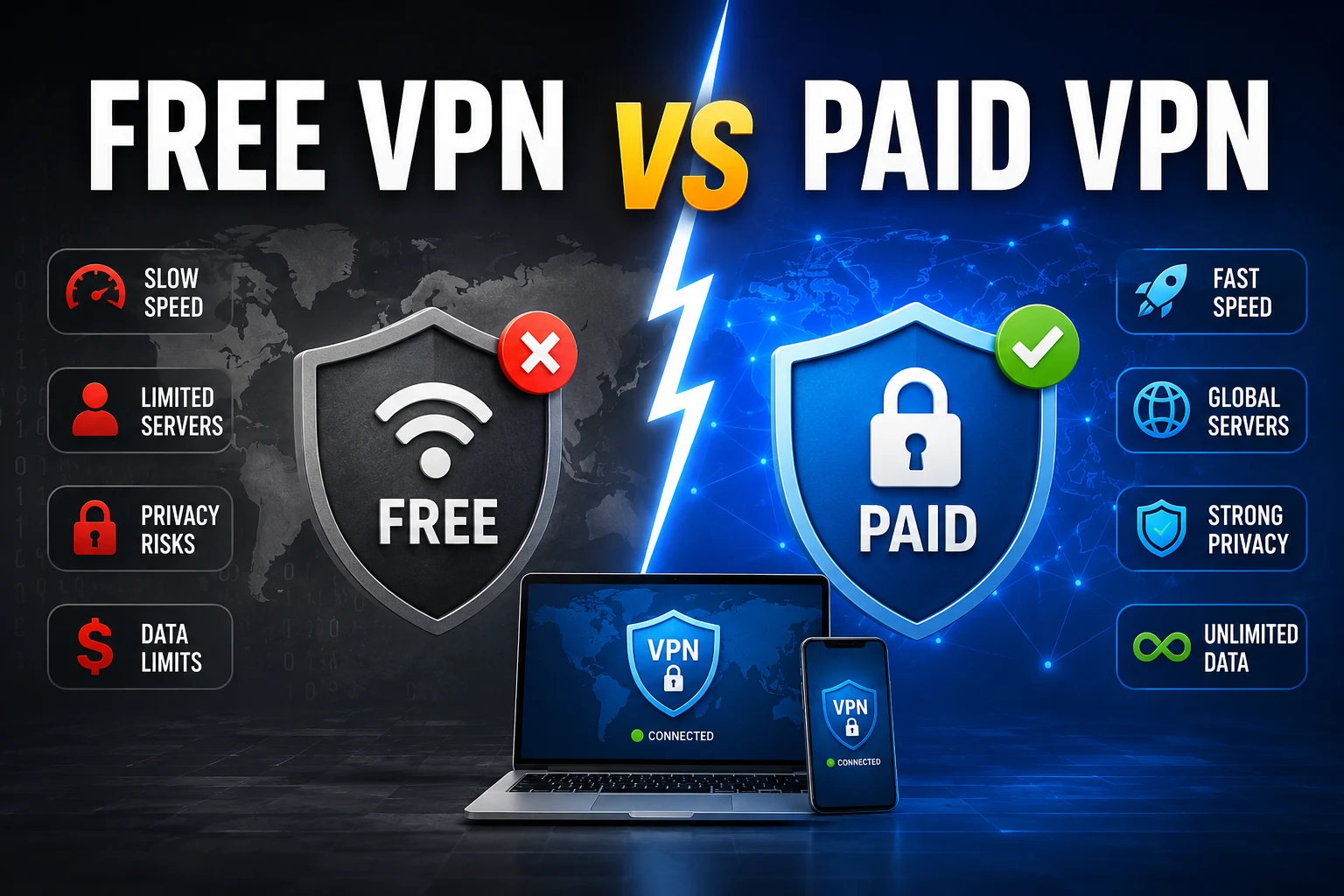
Free vs Paid VPN: Side-by-Side Comparison
| Feature | Free VPN | Paid VPN |
|---|---|---|
| Cost | ₹0 | $1–$5/month |
| Privacy | ❌ Often logs data | ✅ No-logs policy |
| Speed | 🐢 Slow & throttled | ⚡ Fast |
| Data Limit | 500MB–2GB/month | Unlimited |
| Encryption | Weak | AES-256 (Military grade) |
| Server Count | Very few | Thousands |
| Ads/Malware Risk | High | Very Low |
| Streaming Support | Rarely works | Works great |
| Device Support | 1 device | 5–10 devices |
| Customer Support | None/basic | 24/7 live support |
But I Just Want to Watch Netflix. Do I Really Need a Paid VPN?
Fair question. Here’s the honest answer:
💡 Free VPN: Netflix will likely detect and block it. Most free VPNs are already blacklisted by streaming platforms.
💡 Paid VPN: Services like NordVPN, ExpressVPN, and Surfshark are specifically optimized for streaming and regularly update their servers to stay ahead of Netflix’s blocks.
So if unblocking content is your main goal, yes, go paid.
When a Free VPN Might Be Okay
There are a few scenarios where a free VPN is acceptable:
- You just want to try one before buying. Many paid VPNs offer a free trial period instead.
- One quick, low-stakes task. Like accessing a single website once on a trusted network.
- ProtonVPN’s free tier. This is the one exception: ProtonVPN’s free version has no data limits, no ads, and a genuine no-logs policy. It’s slower and has fewer servers, but it’s trustworthy.
My Honest Recommendation
| Your Situation | What to Use |
|---|---|
| Just curious about VPNs | ProtonVPN Free or a paid trial |
| Daily browsing + privacy | Any reputable paid VPN |
| Streaming geo-blocked content | Paid VPN (NordVPN, Surfshark) |
| Public Wi-Fi security | Paid VPN, always |
| Online gaming | Paid VPN with low-latency servers |
| Travelling internationally | Paid VPN |
Bottom Line
Free VPNs sound like a deal until you realize the product is you.
Your browsing data, your habits, and your identity are how free VPN companies make money. And even if they’re not selling your data, weak security means someone else might steal it.
A good paid VPN costs less than a cup of coffee a week. For what it protects, your privacy, your identity, and your data, that’s genuinely worth it.
If budget is a concern, go with Surfshark (very affordable, unlimited devices) or ProtonVPN’s free tier as a starting point.
But whatever you do, don’t trust a random free VPN with your internet life. You deserve better than that.
FAQs: Free vs Paid VPN
Q: Are free VPNs safe to use?
Most free VPNs are not safe. Many log your data, show intrusive ads, or even contain malware. If you want a safe, free option, ProtonVPN’s free tier is the only widely trusted one.
Q: Which free VPN is actually good?
ProtonVPN is the best free VPN available; it has no data cap, no ads, and a verified no-logs policy. Everything else in the “free” category comes with significant trade-offs.
Q: Can a VPN be traced?
A high-quality paid VPN with a strict no-logs policy makes tracing very difficult. Free VPNs that store your logs can absolutely be traced and even handed over to authorities.
Q: How much does a good paid VPN cost?
Good paid VPNs typically cost $1–$5/month when billed annually. Surfshark and NordVPN frequently offer deals that bring this down even further.
Now you know exactly what you’re getting and giving up with both options. Choose wisely.

I'm a tech guy at heart, always exploring, always learning. From AI and modern tech to hands-on how-to guides, I write about the things I discover so you don't have to figure it out alone.