How the Internet Was Actually Invented (The Real Story)
You use the internet every single day. You’re probably on it right now. But have you ever stopped to wonder who actually built this thing? Was it a genius in a garage? A secret government project? A big tech company?
The truth is way more interesting than any of those guesses. The internet wasn’t invented by one person. It wasn’t even invented on purpose, not in the way we think about it today. It grew out of fear, competition, and a bunch of nerdy scientists who just wanted to share research files.
Here’s the real story.
It All Started With the Cold War
To understand the internet, you need to go back to 1957. That year, the Soviet Union launched Sputnik, the world’s first satellite. It was a small metal ball orbiting Earth, but for the United States, it was a wake-up call. If the Soviets could put something in space, they could probably drop a nuclear bomb anywhere on the planet.
The U.S. government panicked in a very organized, scientific kind of way.
In 1958, President Eisenhower created ARPA, the Advanced Research Projects Agency. Its job was simple: make sure the U.S. never got caught off guard by technology again. ARPA was given serious money and told to fund cutting-edge research, no questions asked.
One of the big problems ARPA wanted to solve was communication. If the Soviets launched a nuclear attack, how would the U.S. military still communicate? Phone lines could be destroyed. Radio towers could be bombed. The whole system was fragile.
What they needed was a network that could survive an attack, one where if one part got knocked out, the rest would still work.
That idea became the seed of the internet.
ARPANET: The First Network
By the 1960s, computers existed, but they were enormous, expensive machines. Each one worked on its own. If a researcher at one university needed to use a computer at another university, they had to physically travel there or mail tapes.
That was slow. And ARPA wanted fast.
A scientist named J.C.R. Licklider had a wild idea in 1962. He called it the “Intergalactic Computer Network.” He imagined a system where all computers could talk to each other and share information instantly. People thought he was dreaming.
He wasn’t.
ARPA started funding work on what would eventually be called ARPANET. The key challenge was this: how do you send information across a network reliably, even if part of the network is damaged?
Two researchers, Paul Baran in the U.S. and Donald Davies in the UK, independently came up with the answer: packet switching.
Here’s how packet switching works: instead of sending a whole message through one single path (like a phone call), you break the message into tiny chunks called “packets.” Each packet finds its own route through the network. They might take completely different paths to get to the destination. When they all arrive, they’re reassembled into the original message.
This was brilliant for two reasons. First, it was efficient; you weren’t tying up a whole line just to have a conversation. Second, it was resilient if one path was blocked or destroyed; packets just took a different route.
October 29, 1969: The First Message Ever Sent on the Internet
ARPANET went live in 1969, connecting four universities: UCLA, Stanford, UC Santa Barbara, and the University of Utah.
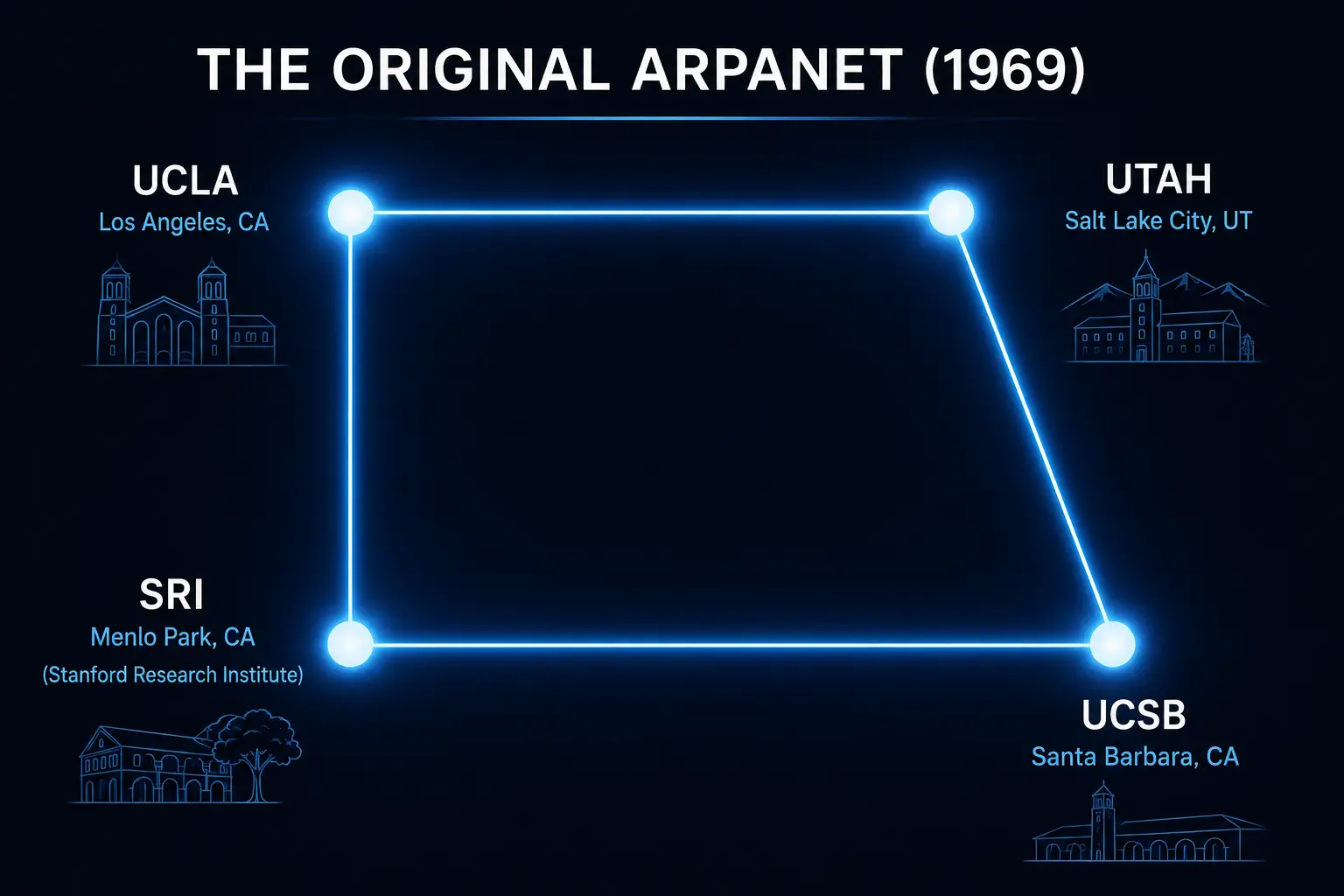
On October 29, 1969, a student named Charley Kline at UCLA tried to send the first message to Stanford. The message was supposed to say “LOGIN.”
He typed “L.” Stanford received it. He typed “O.” Stanford received it. He typed “G.” The system crashed.
So the very first message ever transmitted on what would become the internet was: “LO.”
Not exactly poetic. But historic.
The system was fixed, and the full login worked later that night. But “LO” as in, “Lo and behold” is kind of a perfect accidental first word for the most transformative technology in human history.
From ARPANET to the Internet: The Protocols That Changed Everything
ARPANET worked, but it had a problem: different networks couldn’t talk to each other. It was like having a phone that only called people on the same phone company. If you wanted to connect to a different network, you were out of luck.
That changed in 1974, when two researchers, Vint Cerf and Bob Kahn, published a paper describing a new system. They called it TCP/IP: Transmission Control Protocol / Internet Protocol.
Think of TCP/IP as a universal language. It was a set of rules that any network could follow to communicate with any other network. It didn’t matter if you were on a military network, a university network, or something else entirely. If you spoke TCP/IP, you could connect.
Vint Cerf is often called “the Father of the Internet” because of this work. Though, as he’d probably tell you, plenty of other people deserved credit too.
By 1983, ARPANET officially switched to TCP/IP. This is the moment most computer historians mark as the true birth of the modern internet.
The World Wide Web Is NOT the Internet
Here’s one of the most common mix-ups people make: the internet and the World Wide Web are not the same thing.
The internet is the infrastructure: the cables, routers, servers, and protocols that connect computers around the world. It’s been around since the late 1960s.
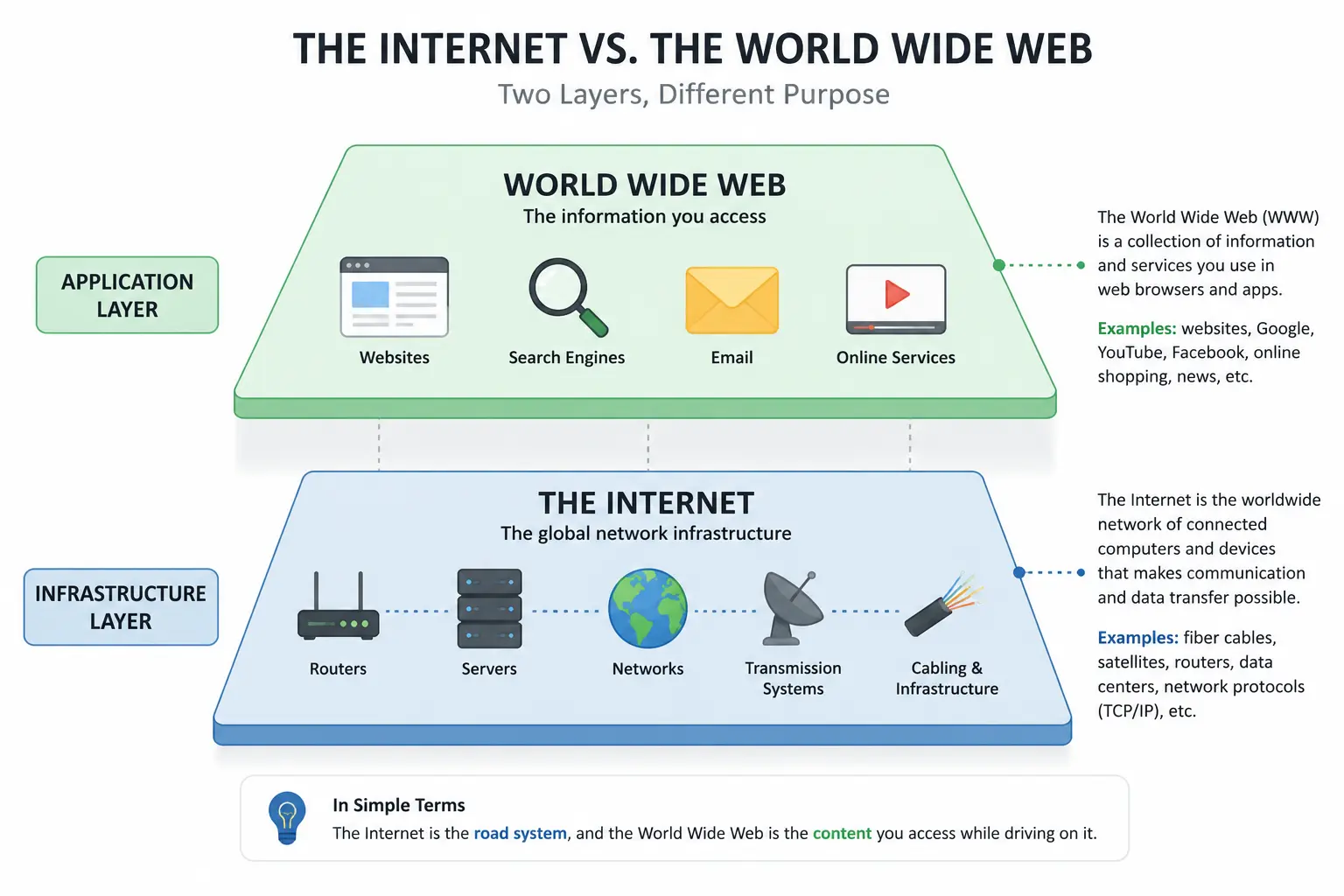
The World Wide Web is a service that runs on top of the Internet. It’s the system of web pages, links, and browsers that most people think of when they think “internet.”
The Web was invented much later in 1989 by a British scientist named Tim Berners-Lee, who was working at CERN, the physics lab in Switzerland.
Berners-Lee wasn’t trying to build something for the world. He was trying to help physicists share research documents. He came up with three ideas that changed everything:
- HTML – a language for creating web pages
- HTTP – a protocol for transferring those pages across the internet
- URLs – the web addresses we type into browsers (like www.example.com)
He put these together and created the first website in 1991. It was just a text page explaining what the World Wide Web was. No images. No videos. No memes.
Berners-Lee also did something remarkable: he gave it all away for free. He never patented the Web. He never charged licensing fees. He just published the code and let the world take it.
That decision is why the internet became what it is today.
The Browser War and the Internet Going Mainstream
For the first few years, the Web was mostly used by academics and tech people. The pages were plain text. It wasn’t exactly exciting.
Then, in 1993, a team at the University of Illinois created Mosaic, the first web browser that could display images alongside text. Suddenly, the Web felt real. It felt like something people might actually want to use.
One of the Mosaic creators, Marc Andreessen, moved to Silicon Valley and co-founded Netscape. Netscape’s browser launched in 1994, and the Internet gold rush began.
By the mid-1990s, AOL was mailing floppy disks (and later CDs) to millions of American homes. People were dialing up. Modems were screeching. The internet was becoming a household word.
Then came Internet Explorer. Microsoft’s browser wars with Netscape in the late 1990s were brutal. Microsoft basically gave IE away for free and bundled it with Windows, slowly suffocating Netscape. (But that’s a story for another article.)
The Dot-Com Boom and Bust
The late 1990s were wild. Money was pouring into internet companies. Companies with no real business plan were getting billion-dollar valuations just because they had a “.com” in their name.
Pets.com. Webvan. Boo.com. These companies burned through cash like it was nothing.
Then, in 2000, the bubble burst. The NASDAQ dropped nearly 80%. Hundreds of internet companies went bankrupt. It looked like maybe the internet hype had been overblown.
It hadn’t. The bubble wasn’t wrong about the internet’s importance. It was just wrong about the timeline.
The companies that survived Amazon, Google, and eBay came out stronger. And the ones that came after, like Facebook (2004) and YouTube (2005), built on the rubble and changed the world.
Who Really Invented the Internet?
So, who invented the internet?
The honest answer: no single person did.
It was Licklider who imagined it. Baran and Davies, who figured out how to make it work. Cerf and Kahn, who gave it a universal language. Berners-Lee, who made it accessible to everyone. And thousands of engineers, researchers, and academics who built on each other’s work over decades.
The internet is one of history’s greatest collaborative projects. No patent. No single founder. Just a chain of brilliant ideas, each one building on the last.
And the most amazing part? The core of it, TCP/IP, the Web, and email, were all given away for free. The people who built the foundations of the internet weren’t trying to get rich. They were just trying to solve problems.
That’s the real story of the internet. And honestly, it’s a lot more inspiring than any garage startup myth.
FAQ: Who invented the Internet?
Q: Who is the official inventor of the internet? There is no single inventor. Key figures include Vint Cerf and Bob Kahn (TCP/IP), Tim Berners-Lee (World Wide Web), and J.C.R. Licklider (early vision). ARPA funded the foundational work.
Q: What was the first internet called? The first network was called ARPANET, launched in 1969 by the U.S. Department of Defense’s Advanced Research Projects Agency.
Q: Is the internet the same as the World Wide Web? No. The internet is the global network of connected computers. The World Wide Web is a system of web pages and links that runs on the internet. The Web was invented by Tim Berners-Lee in 1989.
Q: What was the first message sent on the internet? On October 29, 1969, the first attempted message on ARPANET was “LOGIN,” but the system crashed after two letters. The first message successfully received was “LO.”
Q: When did the internet become available to the public? The internet became widely available to the public in the early 1990s, following the creation of the World Wide Web in 1989 and the launch of user-friendly browsers like Mosaic in 1993.

I'm a tech guy at heart, always exploring, always learning. From AI and modern tech to hands-on how-to guides, I write about the things I discover so you don't have to figure it out alone.