Why Did Google Beat Yahoo? The Inside Story
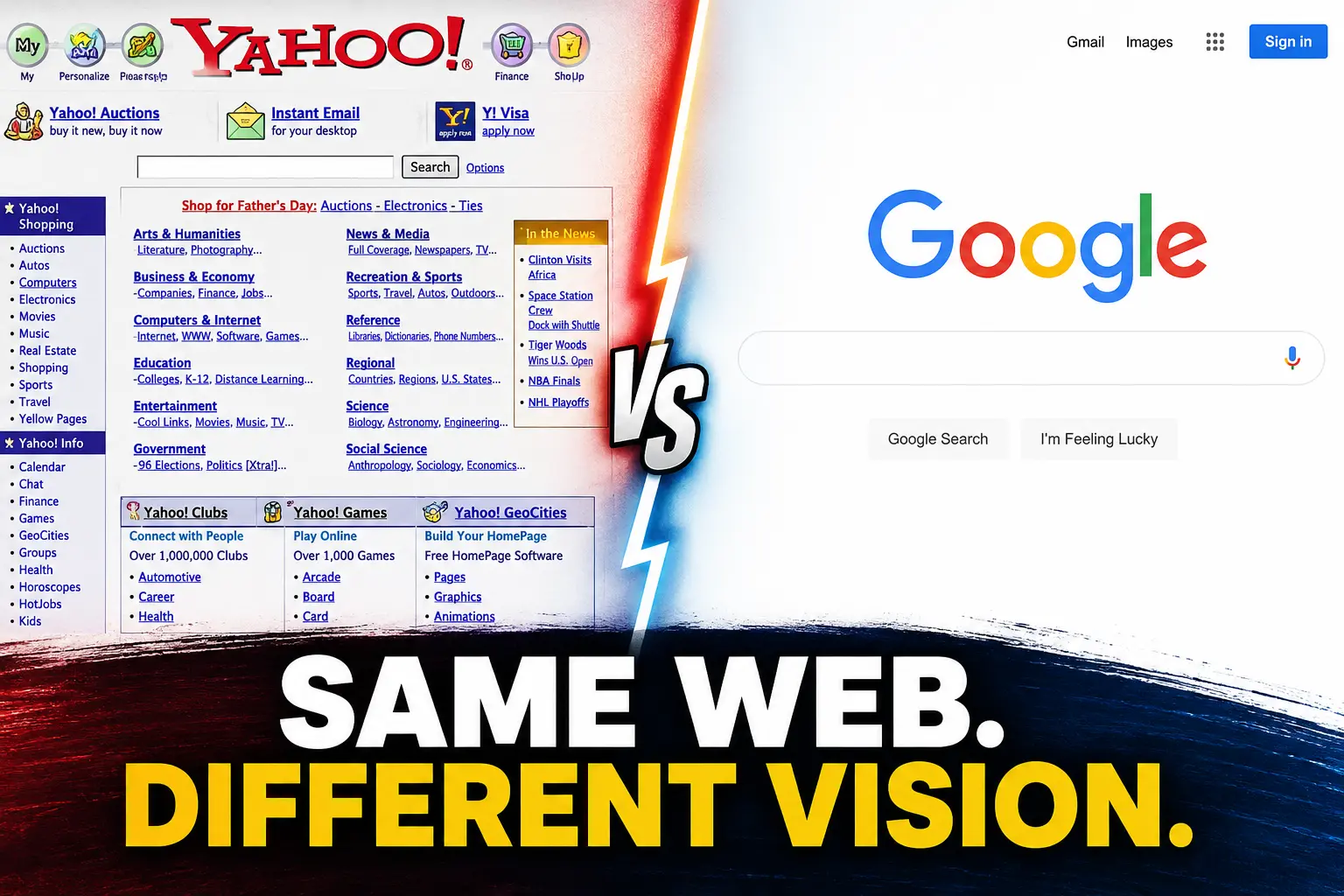
In the late 1990s, if you wanted to find something on the internet, you probably went to Yahoo. Yahoo was an internet company. It had the directory, the news, the email, the fantasy sports, and the chat rooms. It was everywhere.
Then a couple of Stanford PhD students built a search engine in a garage, and within a decade, Yahoo went from the king of the internet to a cautionary tale that business schools still study today.
How did that happen? This is the inside story. Before you continue with the battle between these two internet giants, it’s worth understanding how it all began. Read our guide on how the internet was actually invented.
Yahoo Was Once the King of the Internet
Let’s be clear about something first: Yahoo wasn’t bad. In the mid-to-late 1990s, Yahoo was genuinely great.
Jerry Yang and David Filo started Yahoo in 1994 as a personal hobby; they were keeping a list of their favorite websites while procrastinating on their Stanford engineering PhDs. They called it “Jerry and David’s Guide to the World Wide Web.” Catchy.
They eventually renamed it Yahoo (which stood for “Yet Another Hierarchically Organized Oracle,” yes, that’s real) and launched it as a proper business.
By 1998, Yahoo was the most visited website on the internet. It had 95 million page views per day. It was the place people went when they opened a browser. If you had a business, getting listed in the Yahoo directory was like being in the Yellow Pages, essential.
Yahoo’s model was simple: be the internet’s homepage. Be the place people start their day. Put everything there: news, sports, weather, email, shopping, entertainment. Keep people on Yahoo as long as possible.
It worked brilliantly. Right up until it didn’t.
Meanwhile, Two Stanford Students Were Building Something Different
In 1996, while Yahoo was busy becoming a media empire, Larry Page and Sergey Brin were working on a research project at Stanford. They were trying to figure out which web pages were most important, not by the words they contained, but by which pages linked to them.
The logic was elegant: if lots of websites link to a page, that page is probably pretty useful. It’s like academic citations: a paper that gets cited a hundred times is probably more important than one that nobody references.
They called their ranking system PageRank (a play on Larry Page’s name and the concept of ranking web pages). They built a search engine around it and called it BackRub. Then they renamed it Google, a play on “googol,” the mathematical term for the number 1 followed by 100 zeros.
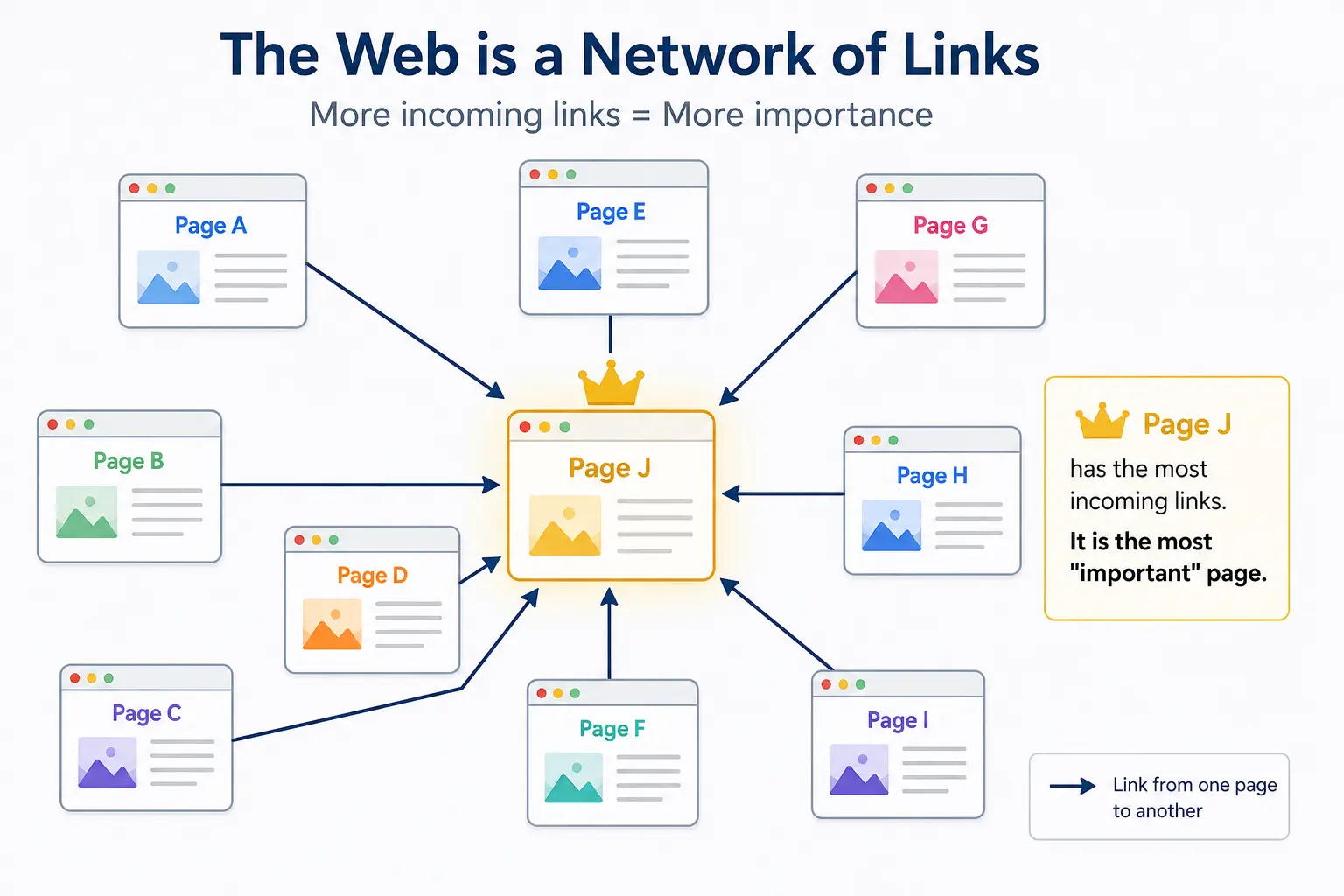
This diagram shows how the Google PageRank system works.
The difference in search quality was immediately obvious. Yahoo’s search at the time was basically a keyword match; if your page mentioned the word “basketball,” it showed up when someone searched for basketball. Google’s results were smarter. They surfaced pages that people actually found useful, based on how the web itself was linking to them.
The Moment Yahoo Could Have Bought Google and Didn’t
Here’s the twist that makes this story almost unbearably ironic.
In 1998, Page and Brin actually tried to sell Google to Yahoo for $1 million. They didn’t really want to run a company. They wanted to finish their PhDs.
Yahoo said no.
The reasoning at Yahoo was that if they bought Google, people would use the search engine and then leave Yahoo to go visit other websites. Yahoo didn’t want that. Yahoo wanted to keep people on Yahoo.
That thinking — “we are a destination, not a tool” — is the core of what eventually killed them.
Google saw itself differently. Google’s job was to get you to your answer as fast as possible, even if that meant you left Google immediately. The faster Google got you out the door, the better Google was doing its job.
These were opposite philosophies, and only one of them matched what users actually wanted.
Google’s Secret Weapon: AdWords
Being better at search was great. But great doesn’t pay the bills.
Google figured out how to make money in a way that was almost too perfect. In 2000, they launched AdWords, a system where businesses could pay to show ads alongside search results, but they only charged those businesses when someone actually clicked the ad.
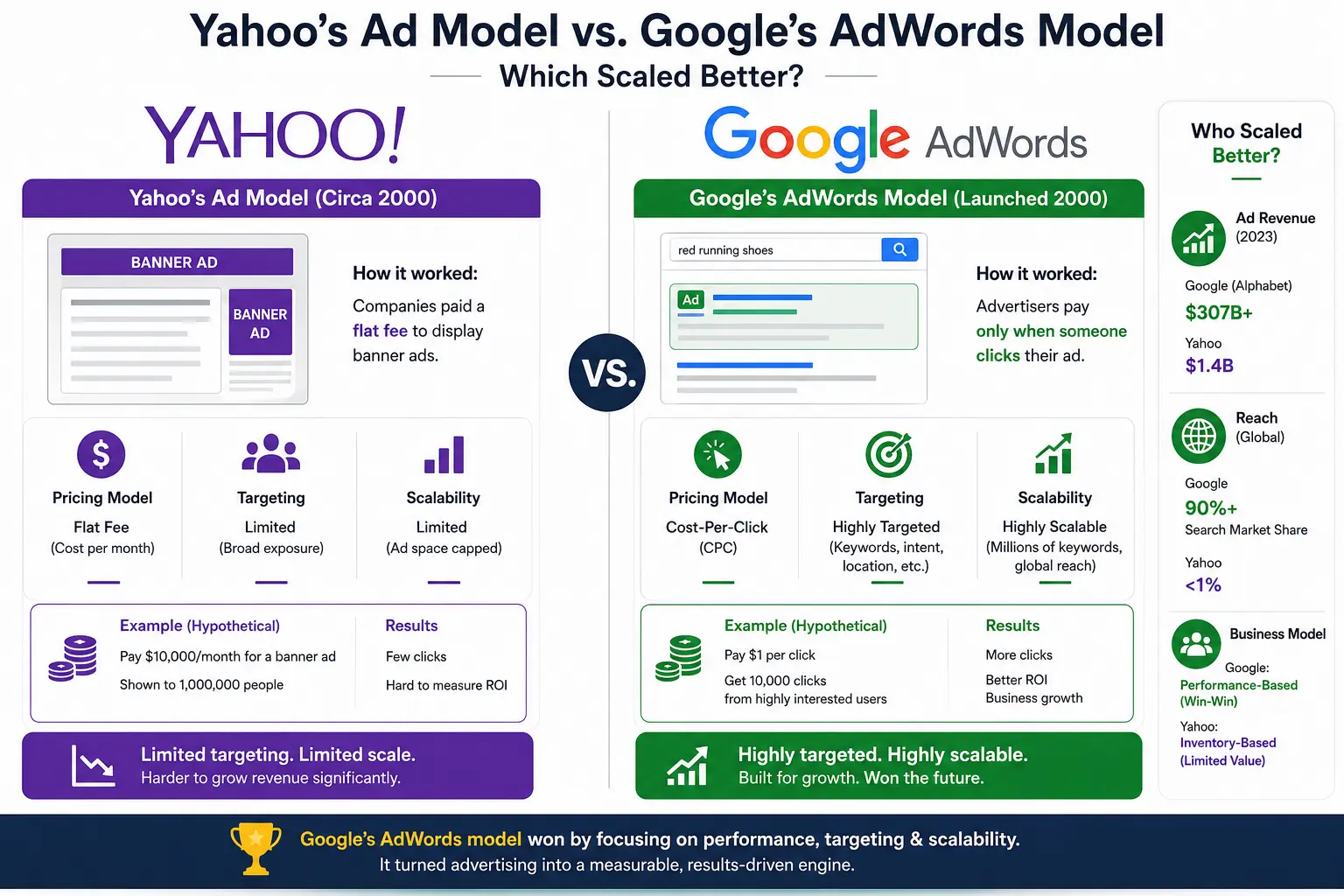
This was revolutionary. Before AdWords, internet advertising was mostly banner ads. You paid for impressions, meaning you paid for the chance that someone might see your ad, whether they cared or not. It was expensive and hard to measure.
AdWords changed everything. You only paid when someone searched for something relevant to your business and actually clicked. If you sold running shoes, your ad showed up when someone searched “buy running shoes.” You paid only when that person clicked through to your site.
The advertisers loved it. The returns were measurable. The costs were justified.
Meanwhile, Yahoo’s advertising model was more like traditional media big brand deals, banner ads, and display advertising. It was profitable, but it wasn’t scalable the way AdWords was.
Google’s ad revenue exploded. By 2004, when Google went public, it was already the most profitable internet company per employee in history.
Yahoo’s Biggest Strategic Mistake: The Search Outsourcing Decision
You’d think losing the search war would be Yahoo’s fatal blow. But Yahoo had another option: they could outsource search entirely and focus on being a media company.
In 2000, Yahoo actually outsourced its search to Google, paying Google to power Yahoo’s search results. This was a reasonable business decision at the time. Yahoo made its money from advertising around search, not from the search tech itself.
But this meant Yahoo was essentially training Google to compete with it. Google got access to enormous amounts of search query data from Yahoo’s users, which it used to make its algorithm even better.
By 2002, when Yahoo realized the mistake and tried to buy Google for $3 billion, Google had become too valuable, and the deal fell through. Google went public two years later at a valuation of $23 billion.
Yahoo then spent $1.6 billion buying Overture, a search advertising company, and rebuilt its own search technology. But by then, Google’s head start was too large to overcome.
Yahoo’s Identity Crisis: Media Company or Tech Company?
While Google stayed laser-focused on search and advertising, Yahoo kept trying to be everything to everyone.
In the 2000s, Yahoo made a series of acquisitions that went in completely different directions. They bought Flickr (photo sharing), del.icio.us (social bookmarking), and a bunch of other properties. Each of these was interesting. None of them fit together into a coherent strategy.
Google, by contrast, stayed focused. Gmail, Google Maps, Google News, YouTube, every product they built or bought was either a better way to get you information or a better way to show you ads. Everything connected.
Yahoo’s homepage became cluttered with links, news tickers, ads, and content from a dozen different directions. Google’s homepage was, famously, just a logo and a search box.
The contrast said everything about the two companies’ philosophies.
The Microsoft Offer That Yahoo Rejected
In 2008, Microsoft made a stunning move: they offered to buy Yahoo for $44.6 billion, a 62% premium over Yahoo’s stock price at the time.
Yahoo’s CEO, Jerry Yang, turned it down. He thought the offer undervalued Yahoo.
Within a year, Yahoo’s stock had dropped significantly, and the same deal would have been worth billions less. Jerry Yang resigned. The Microsoft offer is considered one of the worst decisions in tech history.
By that point, Yahoo had already lost the search war to Google. It had lost the social war to Facebook and Twitter. It had lost market share to Apple and Google. There wasn’t much left to fight for.
Why Google Really Won
The standard explanation is that Google had better search. That’s true, but it’s not the whole story.
Google won because of a combination of factors that reinforced each other:
Better technology, aligned with users. Google’s PageRank produced genuinely better results. Users noticed. They came back. They told their friends.
A business model that scaled with quality. AdWords meant that Google made more money the better its search was. Better search → more clicks → more revenue → more money to invest in better search. A virtuous cycle.
Focused identity. Google knew what it was: a search company. Yahoo never decided whether it was a search engine, a media company, a portal, or something else.
Speed over stickiness. Google is optimized for getting you to your answer fast. Yahoo is optimized for keeping you on Yahoo. Users preferred speed.
Smart restraint on acquisitions. Google bought YouTube and Android, huge wins. Yahoo bought Broadcast.com (remember that?) and a dozen properties that went nowhere.
What Happened to Yahoo?
Yahoo didn’t die overnight. It limped along for years, still generating revenue from its legacy properties, Yahoo Finance, Yahoo Sports, and Yahoo Mail, which remained popular even as the core company lost direction.
In 2016, Verizon bought Yahoo’s core internet business for $4.5 billion. For context, Microsoft had offered $44.6 billion just eight years earlier.
Today, Yahoo’s brands survive under a private equity firm that bought them from Verizon. Yahoo Finance is still widely used. Yahoo Mail still has users. But the company as a force in tech? Gone.
And Google? Worth over $2 trillion. The most visited website on earth. The verb we use for searching the internet.
The Lesson
The Google vs. Yahoo story is one of the most important case studies in tech. It shows that being first doesn’t mean you’ll win. It shows that a clear, focused strategy beats trying to do everything. And it shows that sometimes the most powerful thing a product can do is get out of your way as fast as possible.
Yahoo had the users. Google had the philosophy. Philosophy won.
FAQ: Why Did Google Beat Yahoo?
Q: Why did Yahoo lose to Google? Yahoo lost because it focused on being a destination (keeping users on its site) rather than a utility (helping users find what they needed quickly). Google’s superior search technology, simpler design, and AdWords revenue model created a cycle Yahoo couldn’t break.
Q: Did Yahoo have a chance to buy Google? Yes. In 1998, Google’s founders offered to sell Google to Yahoo for $1 million. Yahoo declined. In 2002, Yahoo tried to buy Google for $3 billion, but the deal didn’t happen. Google went public in 2004 at a $23 billion valuation.
Q: What is Yahoo worth today? Verizon purchased Yahoo’s core internet business for $4.5 billion in 2016. The Yahoo brand (including Yahoo Finance and Yahoo Mail) was later sold to a private equity firm.
Q: What was Google’s key advantage over Yahoo? Google’s PageRank algorithm produced far better search results, and its AdWords system created a business model where the better the search, the more revenue Google earned, a self-reinforcing cycle.
Q: Is Yahoo completely dead? No. Yahoo Finance, Yahoo Mail, and Yahoo Sports still operate and have significant user bases. But Yahoo, as a major tech company and internet portal, is no longer relevant.

I'm a tech guy at heart, always exploring, always learning. From AI and modern tech to hands-on how-to guides, I write about the things I discover so you don't have to figure it out alone.