Bluetooth Mesh Networks Explained: How Your Smart Home Talks Without Wi-Fi
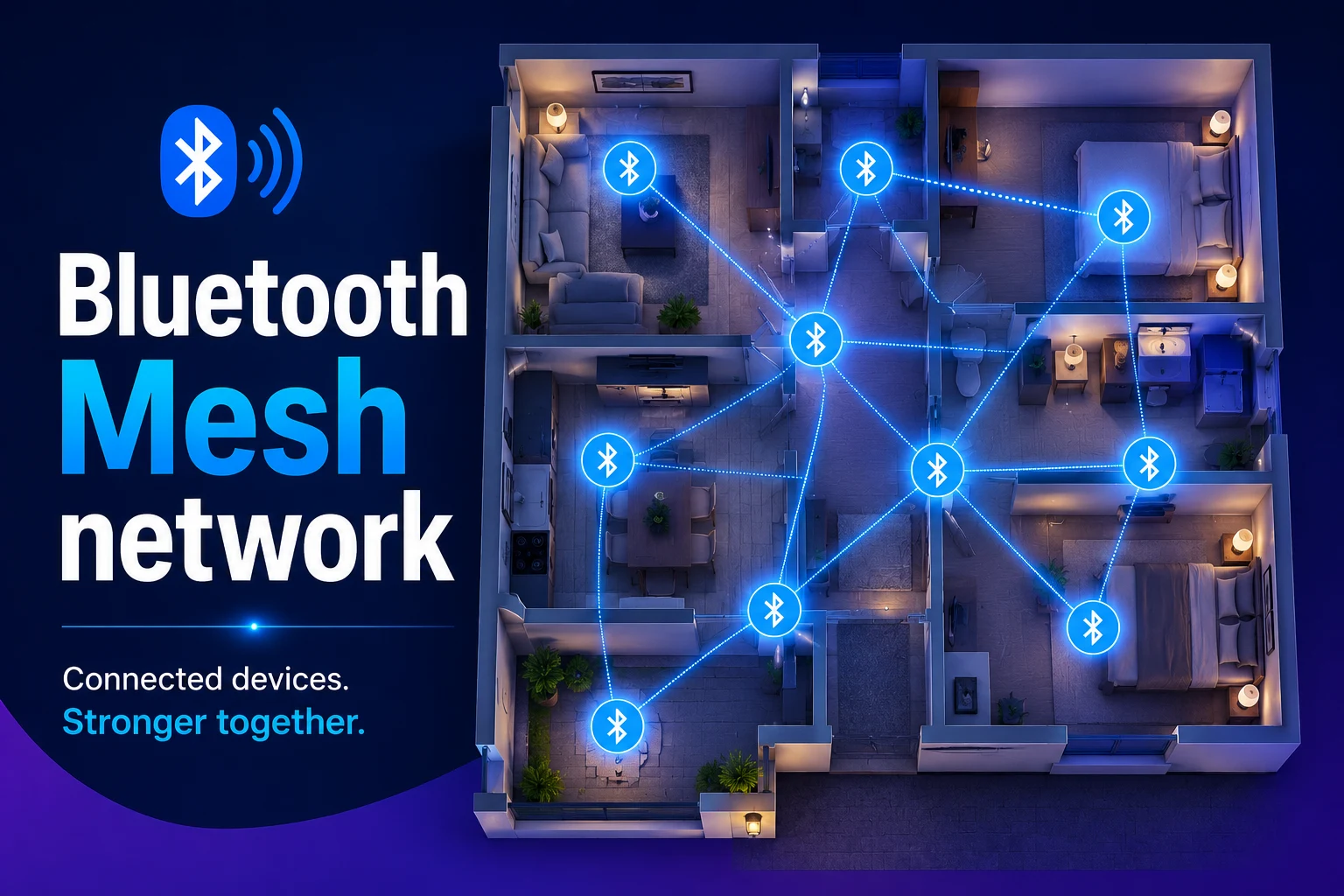
Ever wondered how 50 smart light bulbs in an office building can all turn on and off together without choking your Wi-Fi router?
Or how a warehouse tracks hundreds of pallets in real time without running miles of cable?
The answer is a technology quietly powering millions of devices behind the scenes: Bluetooth Mesh.
You’ve probably used regular Bluetooth to connect your phone to a speaker or headphones. That’s a simple, one-to-one connection. Bluetooth Mesh is a completely different animal. It lets thousands of devices talk to each other at once, passing messages along like a digital game of telephone until every device in the network gets the memo.
Let’s break down what it actually is, how it works, and why it’s becoming the backbone of smart buildings, smart homes, and industrial IoT.
What Is Bluetooth Mesh, Exactly?
Bluetooth Mesh is a networking topology built on top of Bluetooth Low Energy (BLE). It was released by the Bluetooth Special Interest Group (SIG) in 2017 specifically to solve a problem classic Bluetooth couldn’t: connecting large numbers of devices over long distances with reliable coverage.
Traditional Bluetooth works in a “point-to-point” or “star” pattern. Your phone connects directly to your earbuds. If the earbuds are too far away, the connection drops. Simple, but limited.
Bluetooth Mesh flips that model. Instead of every device needing a direct line to a central hub, each device (called a “node”) can relay messages to its neighbors. A message hops from node to node until it reaches its destination, even if that destination is on the other side of a building.
Think of it like a bucket brigade. You don’t need the person at the start of the line to physically carry water to the fire. Each person just passes the bucket to the next. Bluetooth Mesh works the same way with data.
How Bluetooth Mesh Actually Works
At the heart of Bluetooth Mesh is something called managed flooding. Here’s the simple version:
- A message is created. Say a light switch sends a command: “turn on.”
- The message is broadcast, not aimed at one specific device. Every node nearby hears it.
- Nearby nodes relay it. Any node capable of relaying will rebroadcast the message so it reaches nodes further away.
- Duplicate messages get filtered out. Each message carries a sequence number so nodes know not to keep rebroadcasting the same thing forever.
- The right devices act on it. Only nodes that are supposed to respond to that specific message (like the lights in Zone 3) actually do something. Everyone else just relays and ignores it.
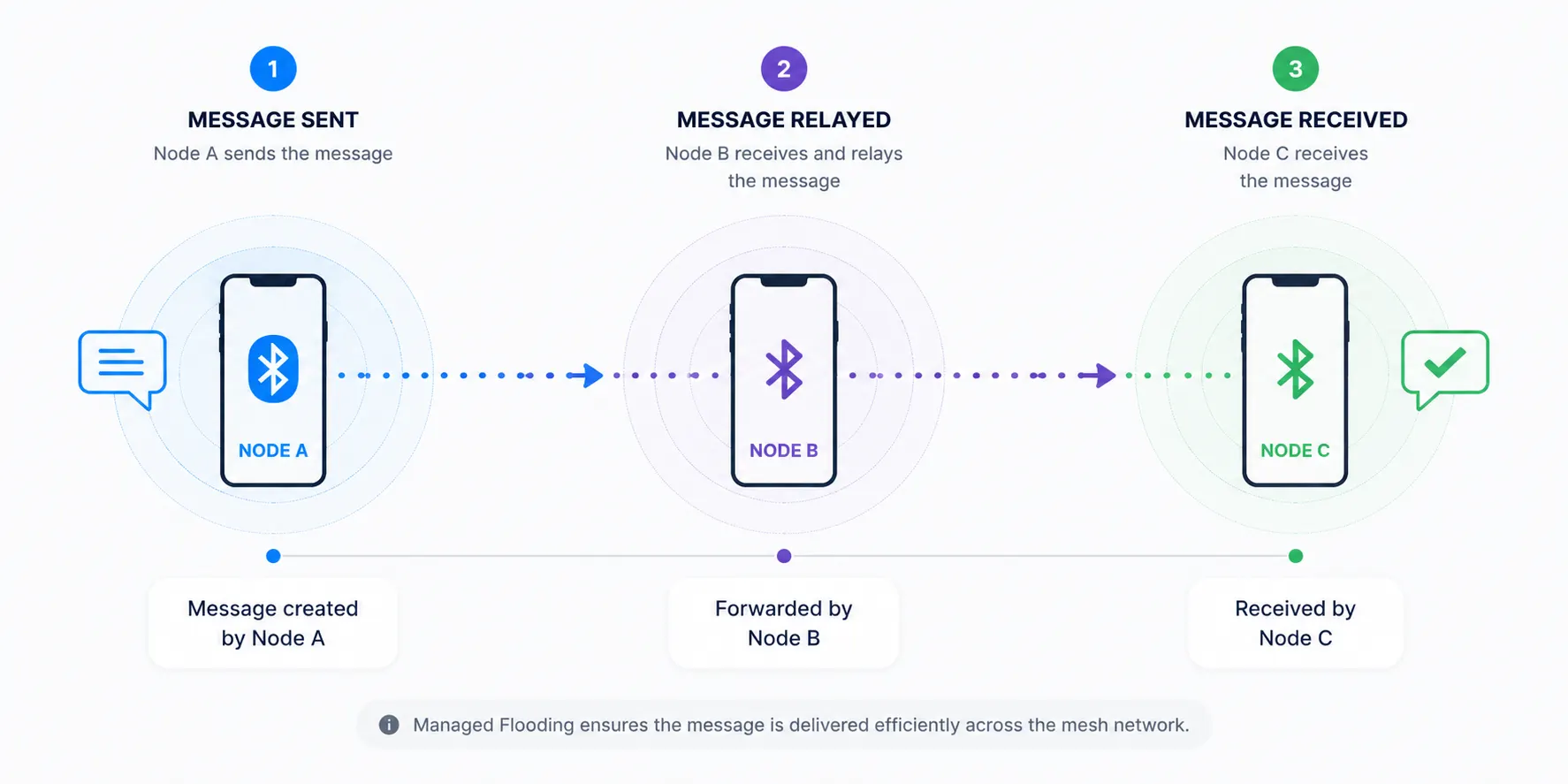
This “flood, but smart about it” approach means the network doesn’t rely on any single device staying online. If one light bulb dies or gets unplugged, the message just routes around it through another path. That makes Bluetooth Mesh networks naturally resilient, which is a big reason they’re popular in commercial buildings where uptime really matters.
Where You’ll Actually Find Bluetooth Mesh
This isn’t a theoretical technology sitting in a lab somewhere. It’s already running in places you interact with regularly:
- Smart lighting systems in offices, hotels, and warehouses, where hundreds of fixtures need to be controlled as one system
- Smart home setups, letting you control lights, locks, and sensors from a single app without needing a separate hub for every brand
- Industrial IoT and asset tracking, where sensors monitor equipment temperature, pressure, or location across a large factory floor
- Indoor wayfinding and beacons, like the ones that guide you through an airport terminal or a big-box store
- Building automation, managing HVAC, security systems, and energy usage across large facilities
The common thread is scale. Bluetooth Mesh shines when you have a large number of low-power devices spread across a wide physical area, and you need them all to communicate reliably.
Bluetooth Mesh vs. Wi-Fi vs. Zigbee: What’s the Difference?
It’s easy to lump all wireless smart-home tech together, but each one is built for a different job.
Wi-Fi is fast and handles a lot of data, which makes it great for streaming video or downloading files. But it’s power-hungry, and most home routers can only comfortably handle a limited number of connected devices before performance suffers.
Zigbee and Z-Wave are also mesh-based, low-power protocols designed for smart homes. They’re mature and well-supported, but they typically require a dedicated hub to translate their signal into something your phone or router understands.
Bluetooth Mesh runs on the same Bluetooth radio already built into your phone, meaning many devices don’t need an extra hub at all. It’s also designed from the ground up to support very large networks, in some cases tens of thousands of nodes, which is far beyond what a typical Zigbee or Wi-Fi setup is built to handle.
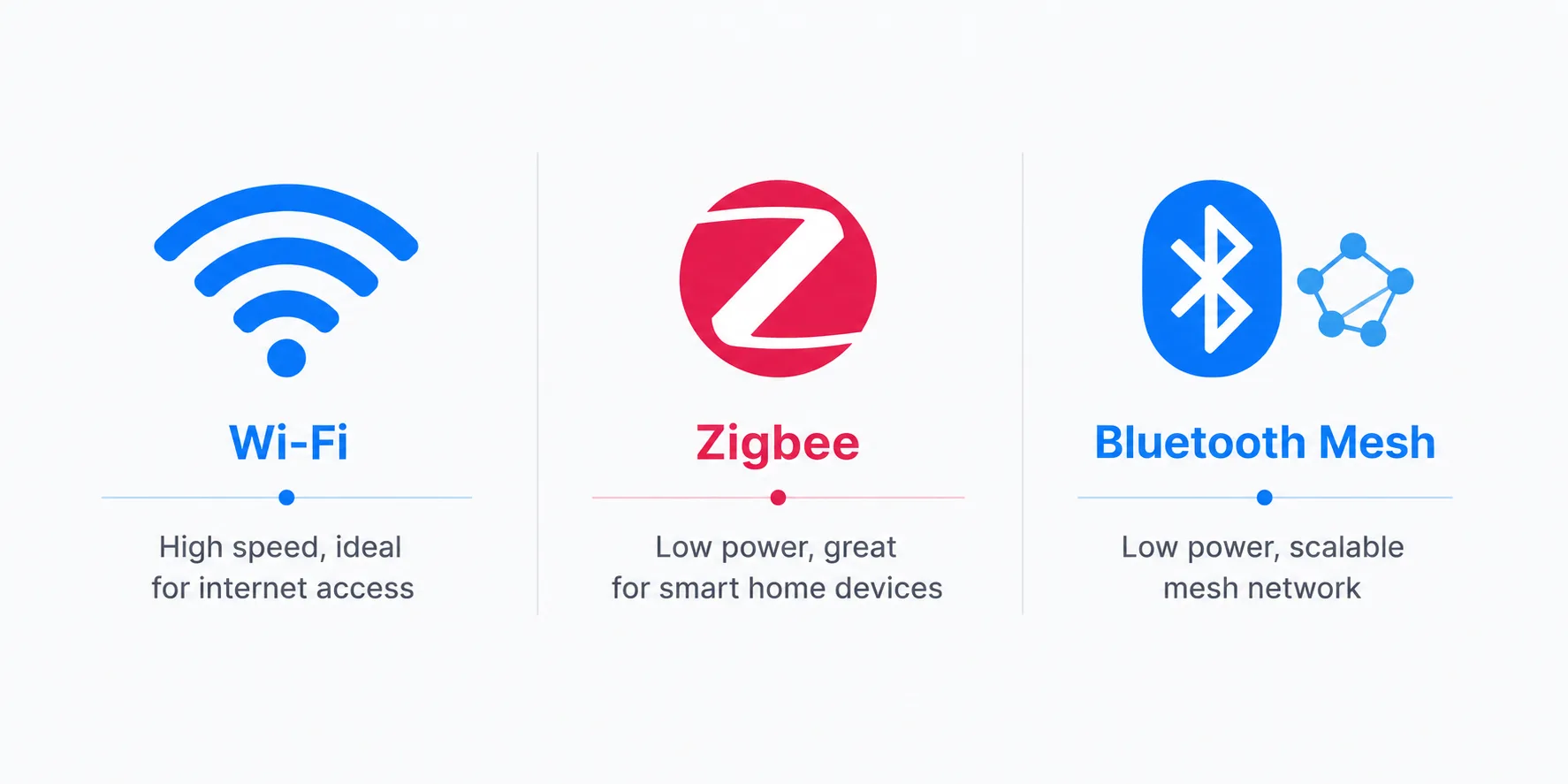
None of these technologies is objectively “the best.” They’re built for different priorities: Wi-Fi for bandwidth, Zigbee/Z-Wave for maturity and hub-based reliability, and Bluetooth Mesh for scale and low power with minimal extra hardware.
The Upsides
- No single point of failure. Since messages can take multiple paths, one dead node rarely brings down the network.
- Massive scalability. Bluetooth Mesh is designed to support tens of thousands of devices in a single network, far more than a typical home Wi-Fi setup.
- Low power consumption. Built on Bluetooth Low Energy, it’s designed for battery-powered sensors that need to last months or years.
- No extra hub required (often). Many implementations let your phone or a simple gateway control the network directly.
The Tradeoffs
- Slower data rates. It’s built for small control messages (“turn on,” “set to 50%”), not for streaming video or large file transfers.
- Setup complexity at scale. Configuring a mesh network with hundreds of nodes requires proper planning, especially around relay nodes and network keys.
- Range depends on node density. A sparse network with too much distance between devices can create dead zones where messages can’t hop through.
- Security setup matters. Because messages are broadcast rather than sent point-to-point, proper encryption and key management are essential to keep the network safe from eavesdropping.
Is Bluetooth Mesh Secure?
Yes, when set up correctly. Bluetooth Mesh uses AES-128 encryption at multiple layers of the network, including separate keys for network access, application data, and device configuration. This layered approach means that even if someone intercepts a message, they can’t easily read or replay it without the right keys. That said, like any wireless technology, security depends heavily on proper implementation; weak default settings or unpatched devices are usually the real vulnerability, not the protocol itself.
FAQ: Bluetooth Mesh Networks
Q. Is Bluetooth Mesh the same as regular Bluetooth?
No. Regular Bluetooth connects two devices directly, like your phone and a speaker. Bluetooth Mesh allows many devices to relay messages to each other, forming a network that can cover a much larger area.
Q. Do I need a hub for Bluetooth Mesh devices?
Not always. Many Bluetooth Mesh products can be controlled directly from a smartphone app, though larger commercial installations sometimes use a gateway device for remote or cloud access.
Q. How many devices can a Bluetooth Mesh network support?
The specification supports networks with tens of thousands of nodes, making it suitable for large buildings, campuses, and industrial sites.
Q. Is Bluetooth Mesh better than Zigbee?
Neither is universally “better.” Bluetooth Mesh offers wider native device compatibility and strong scalability, while Zigbee has a longer track record in home automation with many established hub ecosystems. The right choice depends on the use case.
Q. Can Bluetooth Mesh work outdoors?
Yes, but range and reliability depend on node density and physical obstacles. Outdoor deployments, like campus lighting, typically need careful planning to avoid gaps in coverage.
The Bottom Line
Bluetooth Mesh isn’t trying to replace Wi-Fi or your phone’s Bluetooth connection to your headphones. It’s solving a completely different problem: how do you get thousands of small, low-power devices to reliably talk to each other across a large space without expensive infrastructure? For smart buildings, factories, and increasingly, smart homes, that answer is turning out to be a network that works less like a single hub and more like a well-organized crowd passing messages hand to hand.

I'm a tech guy at heart, always exploring, always learning. From AI and modern tech to hands-on how-to guides, I write about the things I discover so you don't have to figure it out alone.