How Does 5G Technology Enhance the Capabilities of the Internet of Things (IoT)?
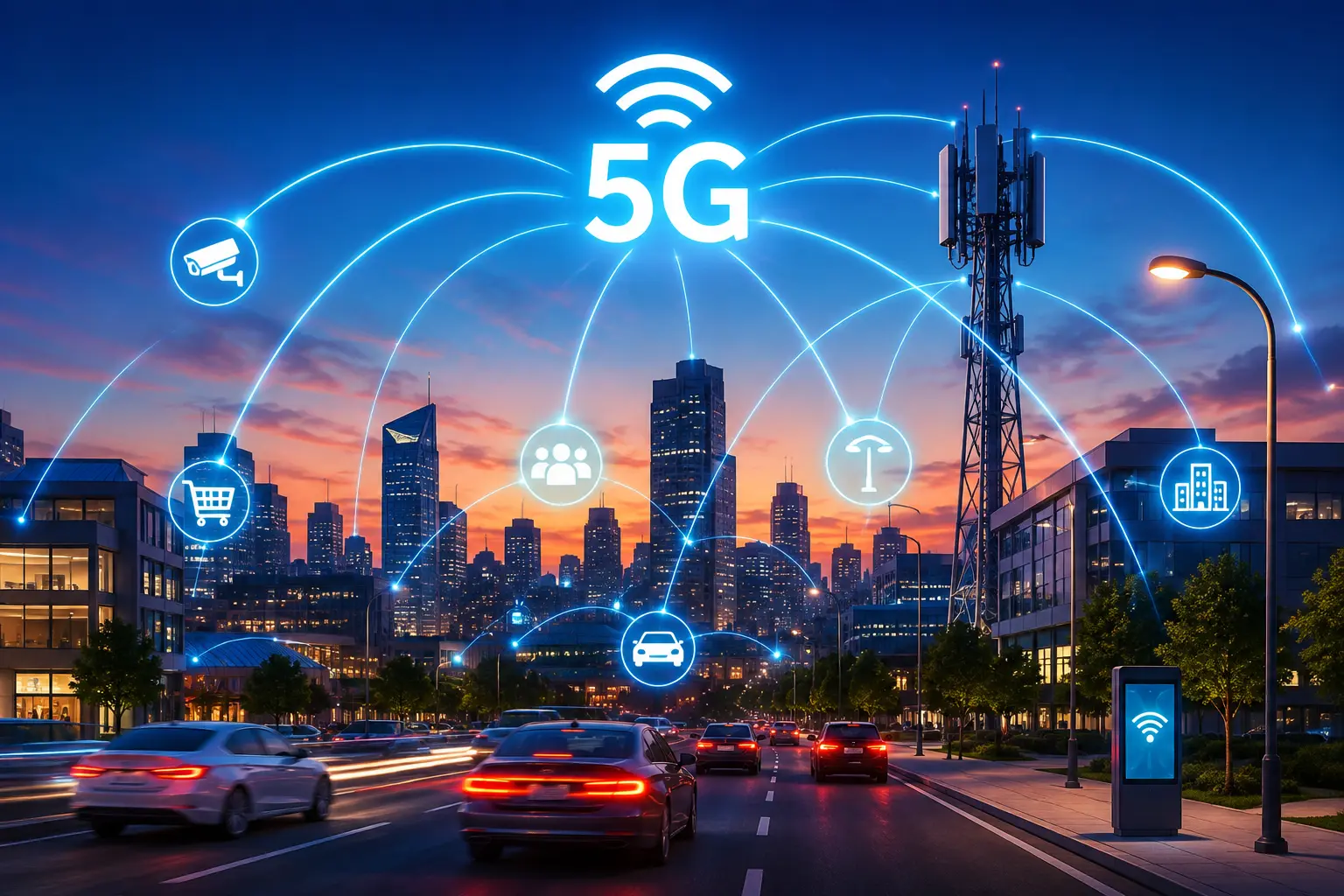
Your smart fridge, your fitness band, and the traffic light at the end of your street are all trying to have a conversation. 5G is what finally lets them talk fast enough to matter.
For years, the Internet of Things (IoT) promised a world where everyday objects quietly talk to each other and make our lives easier. Smart thermostats that learn your schedule. Factory sensors that predict a machine failure before it happens. Cars that “see” a stalled vehicle two blocks ahead. The idea was never the problem; the network was.
4G simply wasn’t built to handle billions of tiny, chatty devices all sending data at once. It was designed for humans streaming video and scrolling social media, not for a warehouse full of sensors pinging every second. 5G changes that math completely, and it’s why IoT is finally growing up from a buzzword into real, everyday infrastructure.
Here’s exactly how 5G is powering that shift and why it matters even if you’ve never thought about network specs in your life.
The Short Answer
5G enhances IoT by offering four things 4G couldn’t deliver at scale: near-instant response times (low latency), the ability to connect huge numbers of devices in one small area (massive connectivity), much faster data speeds, and smarter network management through slicing and edge computing. Together, these upgrades let IoT move from “nice smart home gadgets” to mission-critical uses like self-driving cars, remote surgery, and automated factories.
1. Latency So Low, Devices Feel “Instant”
Latency is the tiny delay between a device sending data and getting a response. On 4G, that delay averages around 50 milliseconds. On 5G, it can drop to under 5 milliseconds, sometimes even 1 millisecond in ideal conditions.
That sounds like a technicality until you picture what it enables:
- A self-driving car detecting a pedestrian and braking before a human could even react
- A surgeon in one city guiding a robotic arm operating on a patient in another
- A factory robot arm adjusting its grip in real time based on a sensor reading
For most consumer IoT (like a smart bulb), a small delay doesn’t matter. But for anything involving safety or split-second decisions, low latency is the difference between “cool gadget” and “technology you can actually trust with your life.”
2. Room for a Massive Number of Devices
A single 5G cell can support around one million connected devices per square kilometer, roughly ten times what 4G could handle in the same space. That number matters more than it sounds like it should.
Think about a smart city: streetlights, parking sensors, air quality monitors, traffic cameras, and public transit trackers all packed into a few city blocks. Or a factory floor covered in hundreds of sensors tracking temperature, vibration, and machine health.
4G networks would choke trying to manage that density. 5G was engineered specifically with this kind of “massive machine-type communication” in mind, so all those devices can stay connected without competing for bandwidth like a room full of people shouting over each other.
Cellular IoT connections have already crossed the billions-of-devices mark globally, and industry forecasts expect nearly 5 billion 5G subscriptions worldwide by the end of 2026, much of that growth coming directly from IoT devices, not just phones.
3. Faster Speeds Mean Richer Data
5G can theoretically hit speeds up to 20 Gbps, compared to 4G’s realistic ceiling of around 100-150 Mbps. Most real-world 5G connections won’t reach the theoretical max, but even a fraction of that is transformative for IoT devices that need to move large amounts of data quickly.
This is what makes high-definition security cameras, drone video feeds, and AI-powered vision systems in factories actually practical over a wireless connection. Instead of choking on a low-resolution feed, devices can stream detailed, real-time data that AI systems need to make accurate decisions.
4. Network Slicing: A Private Lane for Every Use Case
One of 5G’s most underrated features is network slicing: the ability to carve a single physical network into multiple virtual networks, each tuned for a different job.
A hospital might get a slice optimized for ultra-reliable, low-latency connections for remote patient monitoring. A logistics company might get a slice built for wide coverage and long battery life to track shipping containers. A gaming company might need a slice prioritizing speed over almost everything else.
Instead of one-size-fits-all connectivity, 5G lets network operators deliver exactly the kind of connection each IoT use case needs, without one type of traffic slowing down another.
5. Edge Computing: Less Traveling, Faster Decisions
Traditionally, IoT devices sent data to a distant cloud server for processing, then waited for instructions to come back. That round trip adds delay and eats up bandwidth.
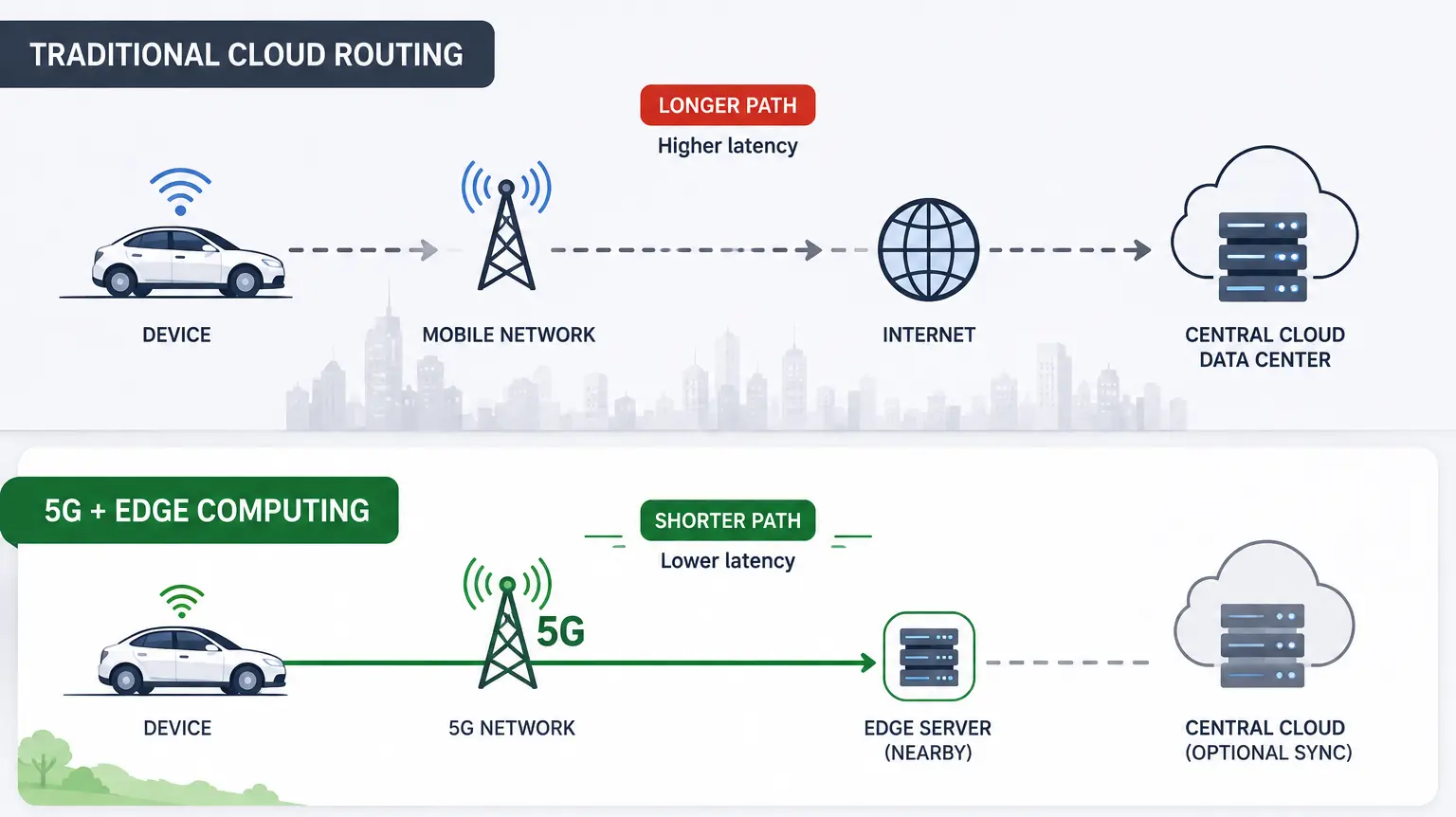
5G networks are built to work closely with edge computing, where data gets processed at servers physically closer to the device, sometimes right at the cell tower itself. That means:
- Less data has to travel long distances
- Devices get responses faster
- Less strain on central cloud servers
- Better privacy, since sensitive data can be processed locally instead of shipped across the internet
For things like autonomous vehicles or industrial robots, this combination of 5G plus edge computing is often what actually makes real-time decision-making possible.
6. Better Battery Life for Simple IoT Devices
Not every IoT device needs blazing speed. A soil moisture sensor in a farm field or a smart water meter just needs to send a tiny bit of data occasionally and ideally run for years on a single battery.
5G includes lightweight standards like RedCap (Reduced Capability) and supports existing low-power technologies like NB-IoT and LTE-M, designed specifically for these simpler devices. Multiple carriers worldwide have already rolled out RedCap support, letting basic sensors get the reliability of 5G networks without needing the power-hungry hardware that high-speed use cases require.
Real-World Industries: 5G-Powered IoT Is Already Reshaping
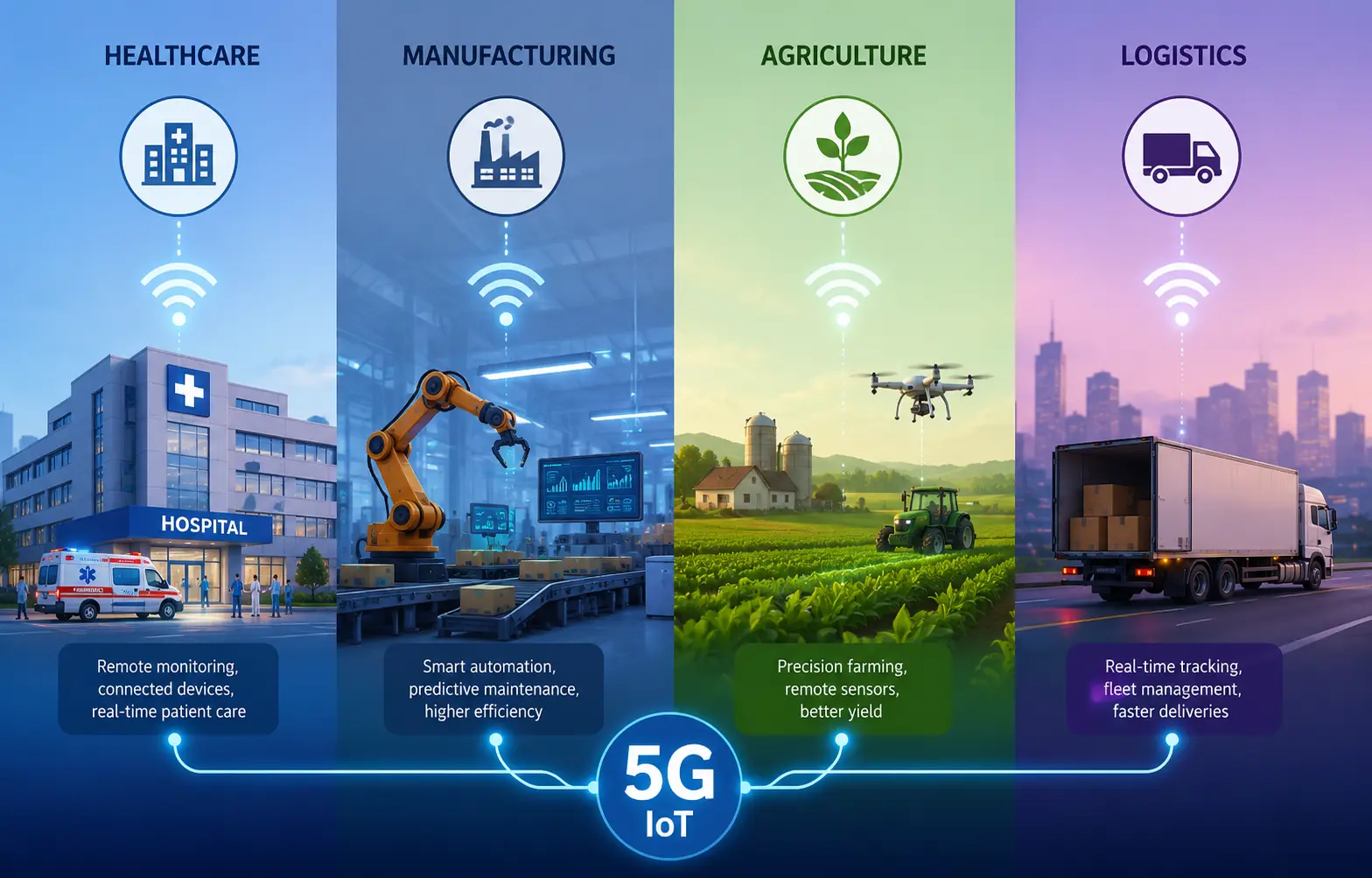
- Smart Cities: Traffic lights that adjust in real time based on congestion, streetlights that dim when no one’s around, and sensors that detect potholes or flooding before they become emergencies.
- Healthcare: Wearables that stream vital signs continuously, connected ambulances that share patient data with hospitals before arrival, and remote patient monitoring that catches problems early.
- Manufacturing: Factories using thousands of sensors and cameras for predictive maintenance, catching equipment failures before they cause costly downtime.
- Agriculture: Fields covered in sensors tracking soil health, weather, and irrigation, paired with drones for real-time crop monitoring.
- Transportation & Logistics: Fleet tracking, smart shipping containers, and the connected infrastructure that autonomous vehicles depend on to operate safely.
Is 5G-Powered IoT Perfect? Not Quite Yet
It’s worth being honest here: 5G isn’t a magic fix for everything.
- Coverage is still uneven. True high-speed 5G (mmWave) has limited range and struggles to penetrate walls, so it’s mostly available in dense urban areas.
- Infrastructure costs are high. Rolling out enough small cells and towers for consistent 5G coverage is expensive, which slows adoption in rural or lower-income regions.
- Security needs to keep up. More connected devices means a bigger attack surface for hackers, so security has to be built in from day one, not bolted on later.
- Device costs add up. Not every IoT device needs full 5G capability, so manufacturers are still figuring out the right balance between cost and connectivity.
These are solvable problems, and progress is happening fast, but it’s fair to say 5G-powered IoT is still in its scaling-up phase rather than fully mature.
The Bottom Line
5G isn’t just a faster version of 4G; it’s a network genuinely built for a world where machines, not just people, are the ones doing most of the talking. Lower latency, room for millions of devices, faster speeds, smarter traffic management, and edge computing all combine to turn IoT from a collection of cool gadgets into infrastructure that entire industries can actually depend on.
The rollout is still ongoing, and coverage gaps remain, but the direction is clear: as 5G networks mature, IoT stops being a “someday” technology and starts becoming the invisible layer running quietly behind smart cities, connected hospitals, automated factories, and yes, eventually, cars that really do drive themselves.
FAQ: How Does 5G Technology Enhance IoT Devices?
Q. Does every IoT device need 5G to work?
No. Simple devices like smart bulbs or basic sensors work fine on Wi-Fi, Bluetooth, or older cellular standards. 5G matters most for IoT applications that need speed, extremely low latency, or the ability to connect huge numbers of devices in one area.
Q. What’s the main difference between 4G and 5G for IoT?
The biggest differences are latency (5G is up to 10x faster to respond), device density (5G supports far more connected devices per square kilometer), and speed. 4G works for basic smart home gadgets, but 5G is what unlocks real-time, large-scale, and safety-critical IoT applications.
Q. Is 5G IoT secure?
5G networks include stronger built-in security features than earlier generations, including better encryption and network slicing that can isolate sensitive traffic. That said, more connected devices always means a larger attack surface, so proper device-level security remains essential.
Q. Will 6G replace 5G for IoT before 5G is even fully rolled out?
6G is still in research and early development, expected sometime around 2030. 5G (and its “5G-Advanced” upgrades) will remain the backbone of IoT connectivity for years to come, so it’s not something to wait on.
Q. What industries benefit most from 5G-powered IoT?
Healthcare, manufacturing, smart cities, agriculture, and transportation are seeing the biggest impact right now, largely because they rely on real-time data and large numbers of connected sensors or devices.

I'm a tech guy at heart, always exploring, always learning. From AI and modern tech to hands-on how-to guides, I write about the things I discover so you don't have to figure it out alone.