What Is Bitchat? The App That Lets You Text Without Wi-Fi or Signal
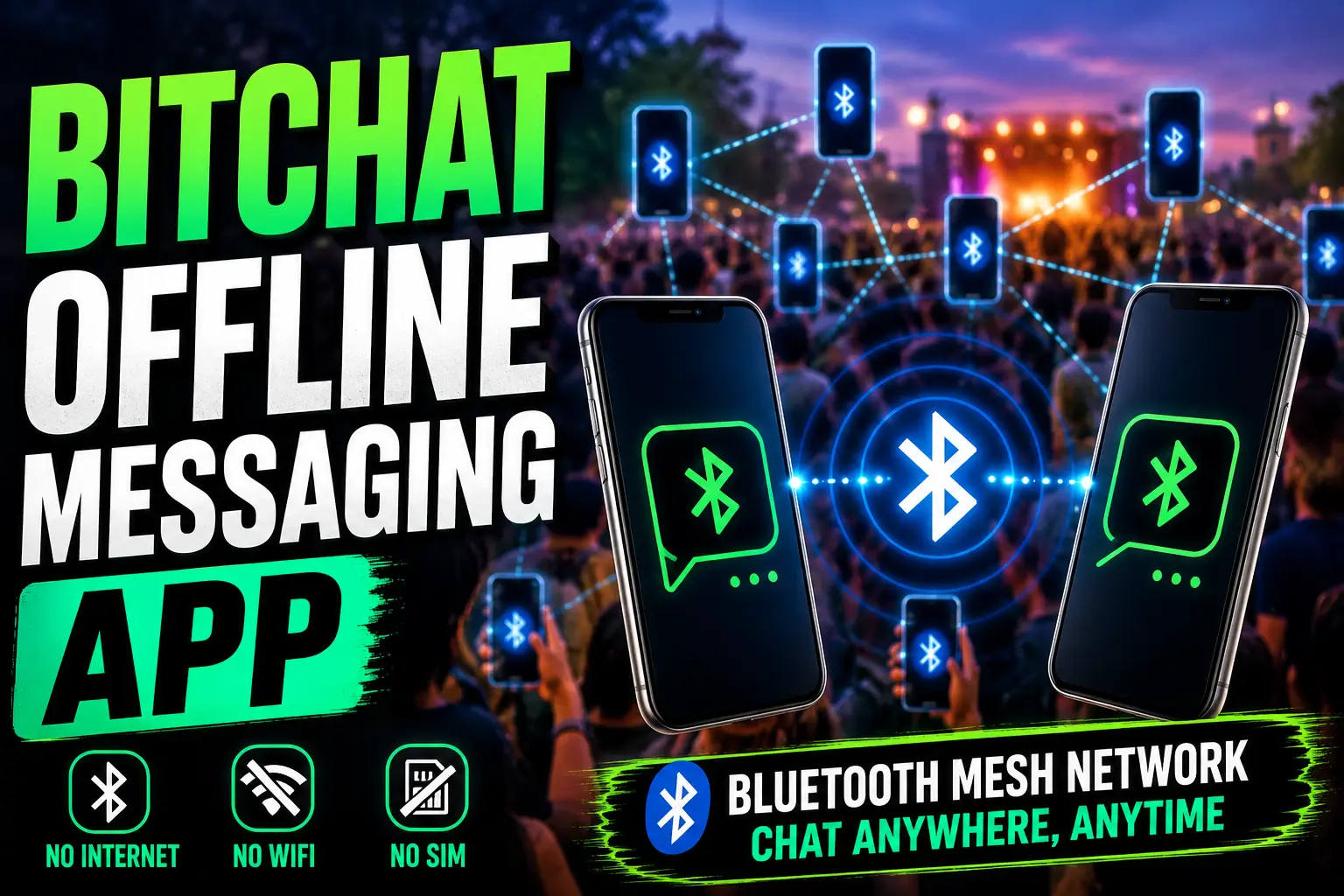
Picture this: you’re at a music festival with 50,000 people, your phone shows full bars, and your text still won’t send. Too many people, too little network. Or maybe you’re on a hiking trail with zero signal and need to tell your friend you’re at the trailhead. Every normal chat app just… gives up.
Bitchat doesn’t.
It’s a messaging app built by Twitter (x) co-founder Jack Dorsey that skips the internet completely. No cell towers, no Wi-Fi, no servers in the middle. It just uses the Bluetooth radio already sitting inside your phone.
What Is Bitchat, Exactly?
Bitchat is a free, open-source messaging app that lets nearby phones talk directly to each other using Bluetooth Low Energy (BLE), the same short-range tech your phone uses for wireless earbuds and smartwatches.
There’s no sign-up. No phone number. No email. No account of any kind. You open the app, pick a nickname, and you can start chatting with anyone else running Bitchat within range.
Dorsey built it in 2025 as what he called a weekend coding project, aimed at solving a problem centralized apps can’t: what happens when there’s no connection at all.
How Does Bitchat Actually Work?
The trick is something called a mesh network. Instead of your message traveling to a distant server and back, it hops from phone to phone until it reaches the person you’re messaging.
Here’s the simple version:
- Direct range: A standard Bluetooth connection between two phones reaches about 30 to 100 meters, depending on the environment.
- Mesh hopping: If your friend is out of range, your message hops through other nearby phones running Bitchat until it finds them. Each device acts like a tiny relay station, extending the network’s reach without any router or tower involved.
- Store-and-forward: If nobody is in range right now, your device holds onto the message and delivers it automatically once a connection appears.
So the more people around you have the app open, the stronger and farther your “network” actually reaches. It’s less like a phone line and more like a bucket brigade passing water hand to hand.
Is Bitchat Actually Private?
Privacy is the other half of Bitchat’s pitch. Since there’s no account or phone number tied to your identity, you’re really just a random nickname to everyone else on the network.
Under the hood, Bitchat encrypts messages end-to-end using established, well-tested cryptography (including the Noise Protocol and Curve25519 key exchange, similar to tools trusted apps like Signal and WhatsApp already rely on). Messages aren’t stored on a central server anywhere, because there isn’t one; they live only on the devices sending and receiving them.
That said, it’s worth being realistic: Bitchat is still young software. It hasn’t gone through the years of independent security audits that older privacy apps like Signal have. If your safety genuinely depends on airtight encryption, that’s worth knowing before you rely on it.
When Would You Actually Use It?
Bitchat isn’t trying to replace WhatsApp or iMessage for everyday chatting. It’s built for the moments those apps fail:
- Crowded events – concerts, conferences, sports games, anywhere too many phones overload the local network.
- Travel dead zones – flights, subways, cruise ships, or remote hiking and camping trips.
- Power or network outages – during storms, earthquakes, or other emergencies when cell towers go down, but people are still nearby.
- Privacy-first chatting – for anyone who’d rather not have a message tied to their phone number or a company’s server.
It’s genuinely useful in short bursts, not as your main texting app.
What Are the Downsides?
Bitchat is impressive, but it’s not magic. A few real limitations:
- Text only. No photos, videos, or voice notes yet, just to keep things fast and lightweight.
- You need other users nearby. Without other Bitchat users close by, the mesh network has nothing to connect to.
- Battery drain. Constant Bluetooth scanning and relaying use more power than your typical messaging app.
- Still evolving. As newer software, expect occasional bugs and rapid updates as the developer community improves it.
Bitchat vs. Signal vs. Bridgefy: What’s the Difference?
| Feature | Bitchat | Signal | Bridgefy |
|---|---|---|---|
| Needs internet | No | Yes | No |
| Needs phone number | No | Yes | No |
| Connection type | Bluetooth mesh | Internet/cellular | Bluetooth mesh |
| Best for | Offline, local chats | Everyday private messaging | Offline, local chats |
| Security track record | New, still being audited | Extensively audited | Established, widely used |
Signal is still the safer bet for daily private conversations since it’s been stress-tested for years. Bitchat and Bridgefy solve a different problem entirely: talking when there’s no network at all.
Frequently Asked Questions
Q. Is Bitchat free?
Yes. It’s free to download and open-source, meaning anyone can inspect or contribute to its code.
Q. Do I need Wi-Fi or mobile data to use Bitchat?
No. It runs entirely over Bluetooth and doesn’t need an internet connection to send or receive messages.
Q. How far can Bitchat messages travel?
A direct connection reaches roughly 30 to 100 meters. With mesh hopping through other users’ devices, messages can travel much farther, hop by hop.
Q. Is Bitchat safer than WhatsApp or iMessage?
It offers strong encryption and no central server, but it hasn’t had the years of independent security auditing that apps like Signal have. It’s private by design, but still maturing.
Q. Who created Bitchat?
Jack Dorsey, the co-founder of Twitter (now X) and CEO of Block, released Bitchat as an open-source project in 2025.
The Bottom Line
Bitchat is a clever answer to a problem every phone user has run into: the moment your signal just disappears. It won’t replace your everyday messaging app, but for festivals, flights, hikes, or emergencies, it’s a genuinely useful tool to have installed and ready. Worth trying, worth understanding, just don’t expect it to fully replace the apps you already trust.

I'm a tech guy at heart, always exploring, always learning. From AI and modern tech to hands-on how-to guides, I write about the things I discover so you don't have to figure it out alone.