Best VPNs for Anime Streaming: Unlock Geo-Locked Shows Fast
You finally have a free evening. You’ve got snacks. You’re ready to binge. And then it happens: “This content is not available in your country.”
If you watch anime, you already know this pain. Half the good stuff on Crunchyroll, Hulu, or a regional Japanese platform is locked behind invisible borders. The show exists. Your account works. You just happen to be standing on the wrong side of a licensing map.
A VPN fixes that. It hides your real location and makes it look like you’re browsing from a country where the show is available. But not every VPN can actually pull this off; streaming sites are aggressive about blocking VPN traffic, and a lot of “top-rated” VPNs buffer, disconnect, or get detected within minutes.
Here are the VPNs that actually hold up for anime streaming in 2026, based on server coverage, streaming speed, and whether they can survive a full binge session without dropping the connection.
Why Anime Gets Geo-Blocked in the First Place
It’s not random. Anime studios and distributors sell streaming rights region by region. A show might be licensed to Crunchyroll in the US but to a completely different platform in Germany or Australia. So the streaming service checks your IP address, the digital “return address” your device sends with every request, and if it doesn’t match an approved country, it blocks the show.
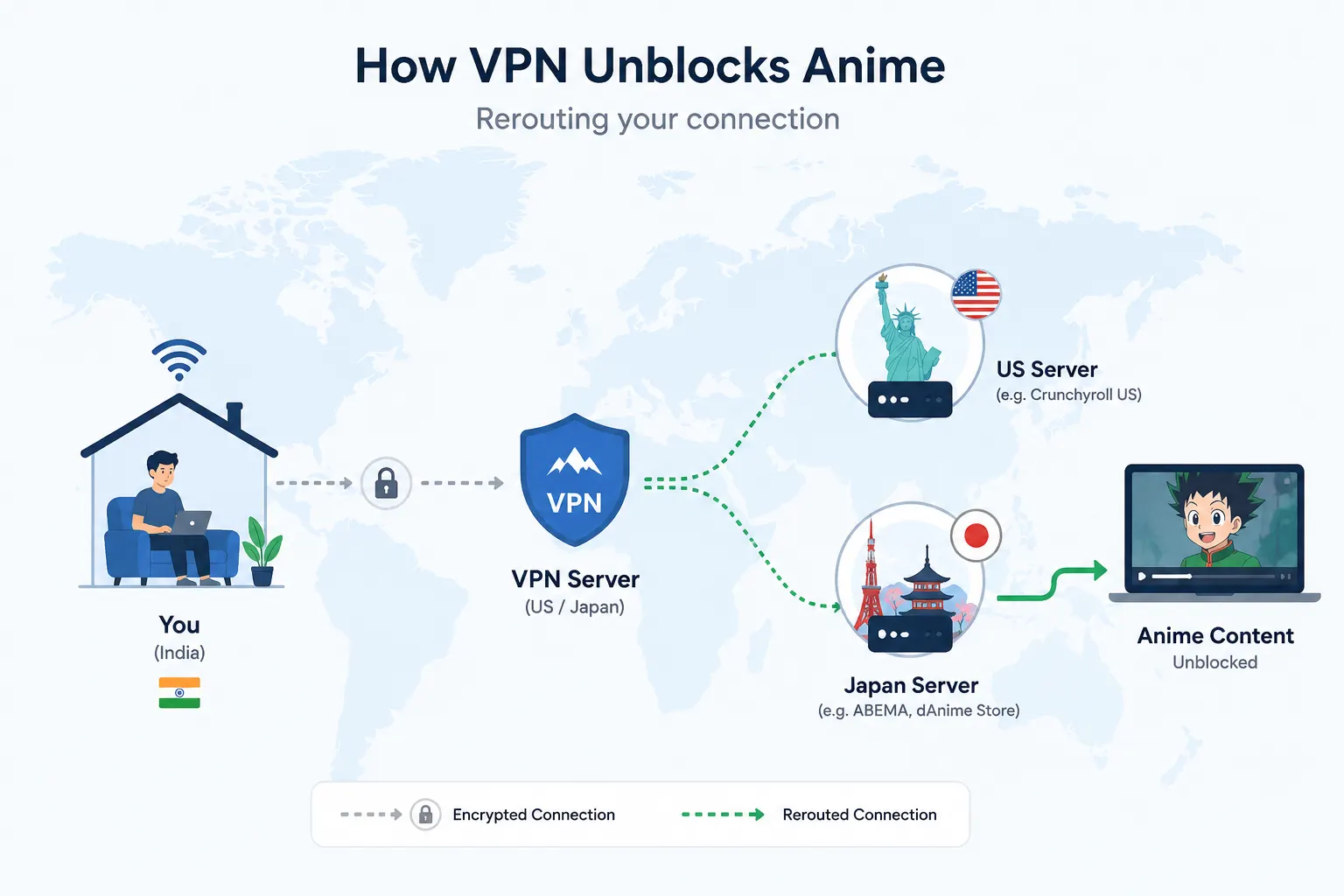
A VPN routes your traffic through a server in another country first. The streaming site sees that server’s location instead of yours, and the geo-block never triggers.
What Actually Matters in an Anime VPN
Before jumping into the list, here’s what separates a VPN that works from one that just wastes your money:
- Speed and stability – Anime is often simulcast in HD close to the Japan broadcast time, and a slow VPN turns crisp animation into a slideshow.
- Server coverage in the US and Japan – Most anime libraries are gated behind these two regions specifically.
- A no-logs policy – You want a provider that can’t hand over your browsing history because it simply doesn’t keep one.
- A kill switch – If the VPN connection drops mid-episode, this instantly cuts your internet so your real IP address never leaks out.
- Enough simultaneous connections – So the whole household can stream on different devices without buying multiple plans.
The Best VPNs for Anime Streaming in 2026
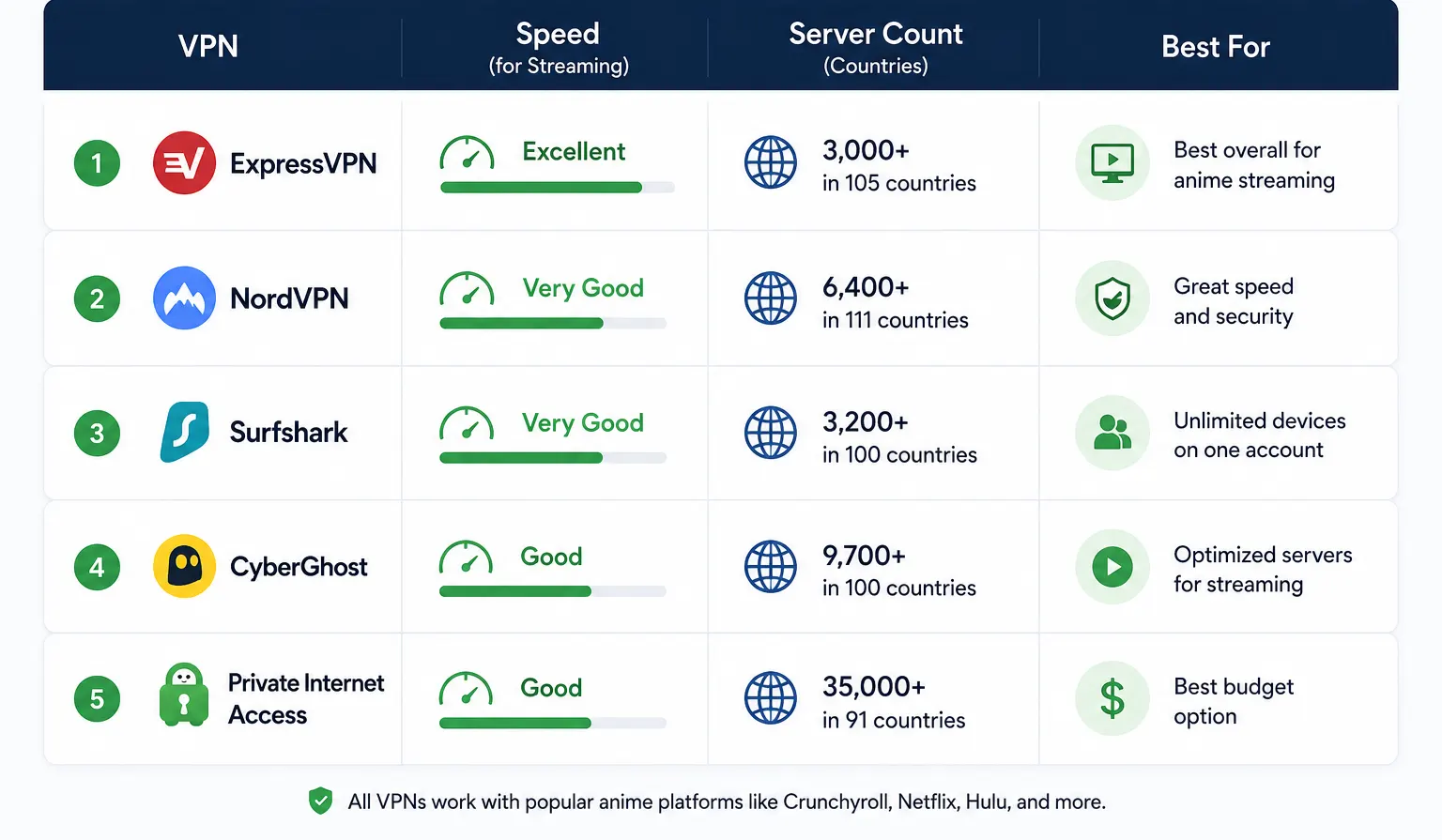
1. NordVPN – Best Overall for Unblocking Anime Libraries
NordVPN consistently comes out on top in independent testing for one simple reason: it has thousands of servers, and it refreshes its US and Japan server pool often enough to stay ahead of streaming sites that try to detect and block VPN IP addresses.
It uses its own protocol, NordLynx, which is built for speed without sacrificing encryption. In practice, that means fewer buffering wheels during a 24-episode weekend binge. It also comes with a strict no-logs policy that’s been independently audited, plus a kill switch and split tunneling, so you can route only your streaming app through the VPN while everything else on your device runs normally.
💡 Best for: People who want one VPN that reliably unblocks everything, not just anime, but Netflix, BBC iPlayer, and Disney+ too.
2. Surfshark – Best for Streaming on Every Device You Own
Surfshark’s biggest selling point is simple: unlimited simultaneous connections. One subscription covers your phone, laptop, tablet, smart TV, and your roommate’s laptop too, without any device limit.
It also has a dedicated “Smart DNS” style approach to streaming and a huge server count for the price, including strong coverage in the US and UK. Speeds are close to NordVPN’s, and the CleanWeb feature blocks ads and trackers, which is a nice bonus when you’re browsing anime torrent-adjacent sites that are usually covered in sketchy pop-up ads.
💡 Best for: Households or shared accounts where multiple people need to stream at once on a budget.
3. ExpressVPN – Best for Speed and Simplicity
ExpressVPN is the VPN equivalent of a car that just starts every time. It’s not the cheapest option, but it’s built for people who don’t want to think about settings, servers, or troubleshooting – you open the app, hit connect, and it works.
Its Lightway protocol is optimized for both speed and battery life, which matters if you’re streaming anime on your phone during a commute. It also maintains servers in Japan, which is genuinely useful for accessing region-specific simulcasts that release before the international version drops.
💡 Best for: People who want a “just works” experience and are willing to pay a bit more for it.
4. Proton VPN – Best for Privacy-Focused Streamers
Proton VPN comes from the same team behind the encrypted email service Proton Mail, and that privacy-first reputation carries over. It publishes transparency reports, runs on open-source apps that security researchers can inspect, and still manages to deliver strong streaming speeds – recent testing has clocked its US servers averaging well over 250 Mbps.
It’s slightly less aggressive at unblocking every single regional platform compared to NordVPN, but for major anime hubs like Crunchyroll and Hulu, it holds up well.
💡 Best for: Anyone who cares as much about privacy as they do about unblocking their next episode.
5. Private Internet Access (PIA) – Best for Customization
PIA is the choice for people who like to tinker. It offers deep customization over encryption settings, port selection, and its own ad-and-tracker blocker called MACE. It also has one of the largest server networks in the US specifically, which helps when a streaming site blacklists one server IP, and you need to hop to another instantly.
It’s not quite as beginner-friendly as ExpressVPN, but if you want control over exactly how your VPN behaves, PIA gives you the dials to adjust.
💡 Best for: More technical users who want fine-grained control over their setup.
How to Actually Watch Geo-Locked Anime With a VPN
- Subscribe to one of the VPNs above.
- Install the app on the device you’ll actually stream from.
- Open the app and connect to a server in the country where the anime is available (usually the US or Japan).
- Open your streaming service and refresh the page.
- Press play.
If a show still won’t load, try switching to a different server in the same country; streaming platforms sometimes blacklist individual server IPs, and a fresh one usually clears the block right away.
Is It Legal to Use a VPN for Anime?
Using a VPN itself is legal in most countries. What’s murkier is whether it breaks a streaming platform’s terms of service, since most of them explicitly say you shouldn’t use a VPN to access content outside your region. In practice, streaming services rarely take action against individual accounts for this; they focus their energy on detecting and blocking VPN servers, not punishing users. Still, it’s worth knowing you’re technically bending the platform’s rules, even if enforcement against individuals is close to nonexistent.
FAQ: Best VPNs for Anime Streaming
Q. Do I need a paid VPN to watch geo-locked anime?
Free VPNs almost always fail here. Streaming sites maintain blocklists of known VPN IP addresses, and free services tend to reuse the same small pool of servers, which get blacklisted fast. A paid VPN with a large, frequently refreshed server network is what actually gets you in.
Q. Which country’s server should I connect to for the most anime?
The US usually has the widest anime library across platforms like Crunchyroll and Hulu, but Japan-based servers can unlock simulcasts and region-exclusive titles that aren’t available anywhere else.
Q. Will a VPN slow down my streaming quality?
A good VPN adds only a small amount of latency, which is usually not noticeable. This is exactly why server count and protocol quality matter; cheaper VPNs with fewer servers are where the real slowdown happens.
Q. Can Crunchyroll detect and block VPNs?
Yes. Crunchyroll actively blocks known VPN server IPs, which is why the VPNs on this list are singled out; they maintain large enough server pools to stay ahead of these blocks and swap servers quickly when one gets flagged.
Q. Is it safe to enter my streaming password while connected to a VPN?
Yes. A reputable VPN encrypts your connection, which actually makes entering passwords and payment details safer, not riskier, especially on public Wi-Fi.

I'm a tech guy at heart, always exploring, always learning. From AI and modern tech to hands-on how-to guides, I write about the things I discover so you don't have to figure it out alone.